|
Prof. F.A. Brookes and E. Stanley Brookes
a family lineage of photographers and performers
Gael Newton AM April 2025
Clarification: 'Professor' F. A. Brookes full name was Frederick Augustus Stanley Brookes.
He preferred to use F. A. Brookes; also 'Professor'
F. A. Brookes.
For this piece I am using Frederick Brookes or Frederick when talking about the father - the'professor'.
The son is E Stanley Brookes, whose name is Edwin Stanley, I will refer to him as Stanley Brookes or Stanley.
The term 'professor' was Frederick's own doing, as performers often did at this time.
Frederick Brooks: Born 1852 Nottinghamshire, England – died 1922 Rockdale, NSW, Australia.
Frederick's brother – Albert Edward Brookes: born c.1847 Nottinghamshire – died c. 1907 New Zealand
Frederick's son – Edwin Brooks: Born 1889 Essendon, Mellbourne – died 1983 Windsor, Melbourne
 |
|
 |
Esther Paterson 1892-1971
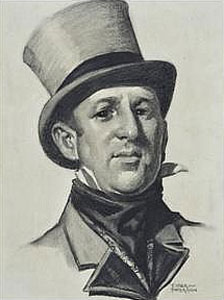
Edwin Stanley Brookes portrait in top hat possibly in costume, conti and charcoal |
|
Esther Paterson 1892-1971
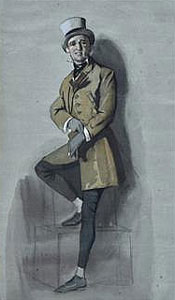
Melbourne Actor Edwin Stanley Brookes (as Dickens Micawber) 1930 Charcoal drawing, Watercolour and body colour |
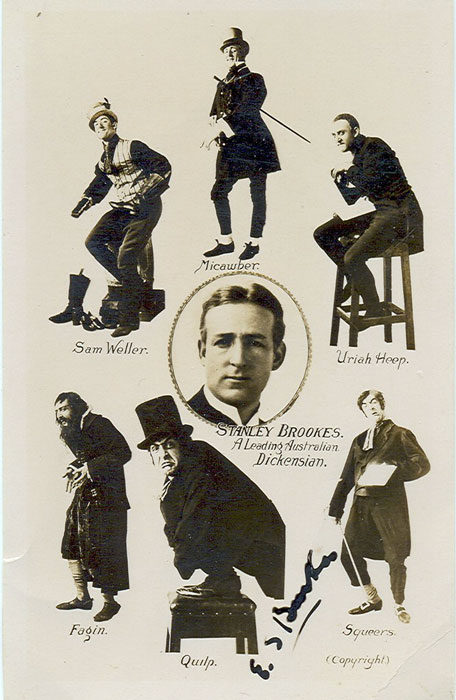
In 2024 I assisted with the placement in the National Library of Australia of two portraits by early to mid 20th century Australian artist Esther Paterson (1892-1971). The 1930s portraits were of of Melbourne Stanley Brookes. The research covered the career of his British father Frederick Brookes who was a lecturer, painter and photographer in San Francisco, New Zealand and in Victoria from the 1880s–1910s. Frederick was a prominent 19th-century photographer and artist active in Melbourne and regional Victoria. His son Stanley was from the 1920s to 1950s a Melbourne elocutionist best known for his one man recitals as characters in Charles Dickens novels.
Esther Paterson had a busy career in Melbourne as a painter, illustrator and cartoonist and has been the subject of several monographs. She is among the lesser known professional women artists of the early to mid 20th century.
Her portraits show Stanley Brookes in costume for one of his popular stage recitals as the optimistic but inept Mr Micawber from Charles Dickens 1850 novel David Copperfield. That character was based on Dickens' own father who spent time in a debtor’s prison and appears also to fit the character of Stanley Brooke’s artist-artist photographer father Frederick Brookes. Frederick was the son of a reverend who organised the Albertland migrant colony New Zealand. Brookes forebears in England may have been silhouette artists in the early 19th century.1
Frederick Brookes had spent time in America in the 1870s reputedly as a scout and joined Buffalo Bill’s wild west troupe and was advertising lessons and examples in the Ivory type process in San Francisco in 1880. He was in New Zealand working as a portrait and ivory painter by 1882. In 1885 he was presenting a lantern slide panorama entertainment showing topical interests including the Soudan War, Emigrant Ship, Italy, Niagara Falls, as well as Holland and English scenery.
He married in 1881, migrated with his wife Elizabeth to Australia and was working as an artist photographer in Moonee Ponds Melbourne by 1889. Frederick Brookes advertised a special American convex oil portrait on glass process called an ivory type. He was also in business with his brother Albert Edward Brookes in Geelong in 1889–90 as ‘Brookes Photographic Union’.
The firm produced two albums of views of Western District, Geelong and Bellarine Peninsula, and Gippsland. Frederick Brookes appears to deserted the family in1895 but was taking photographs of the Jerusalem panorama at the Melbourne cyclorama as manager in 1928. He died under the name Musgrave in Rockdale New South Wales with a second family.2
Edwin Stanely Brookes (son of Frederick) known as Stan to friends and family, was very athletic and could assume the physiognomy of various Dickens characters. In an extensive profile 19 May 1932 the Burnie Advocate reported, reported how Stanley Brookes ‘reduced himself from a man almost six feet to a creature only 26 inches high, and maintaining this dwarfed attitude, he springs from the stage on to an ordinary table and hops about like a spring-heeled Jack!’ Stanley Brookes toured extensively Australia and New Zealand with the Australian-American Chautauqua Concert Company in the mid 1920s.
Stanley Brookes may have studied at the Melbourne Art Training Institute was a printer before studying elocution and becoming a touring performer, teacher, pioneer radio and film broadcaster as well as a regular judge at elocution competitions in Australia and New Zealand. In the 1920s he was an extension lecturer in public speaking at Melbourne University. He trained pupils for radio and stage work at his Melbourne studio and claimed a number of pioneer roles in Australian broadcasting.3
Stanley served as President of the Players and Playgoers Association in 1955. The latter had been formed in 1933 by former theatre performers, staff with club rooms in the Nicholson Building in Melbourne. His career is mentioned in Joy Damousi’s 2010 survey Colonial Voices: A Cultural History of English in Australia, 1840-1940.4 Stanley Brookes supported an Australian English style but his declamatory elocution style suited to the stage was outmoded by a more natural diction once the ABC radio was established in Australia.
Stanley Brookes made visits to New Zealand and spent fifteen months in North America and England in 1934-36 as a touring Dickens lecturer and elocution performer. He claimed in Montana, America that he had been made an honorary red Indian because his father had befriended Sioux.
Stanley Brookes was not shy about public profile. In 1958 he self published a long account of his career and many claims to pioneer role in radio work in Melbourne, in a special supplement to the newsletter of the Bread and Cheese Club Melbourne of which he was the Knight Grand Cheese. (see link below)
He wrote frequent letters Melbourne newspapers in the 1940s and 50s on a range of topics. By the 1940s Stanley Brookes became involved with spiritualism and claimed to regularly converse with his dead father. He became a President of the Psychical and Occult Research Society. In August 1953 he conversed with the spirit of Conan Doyle through a radio station 3AW Melbourne and in 1968 he wrote a book My 4000 Ghosts on his reincarnations and conversations.
Frederick and Stanley Brookes had roles as entrepreneurial, independent public educators and entertainers constantly touring and performing in person. Their legacy has slipped below the general historical radar post WWII but is a part of the prehistory of modern media.5
- Directories list him as an artist and photographer in Ascot Vale and Moonee Ponds, Melbourne, in 1888-89. However, the death of his infant son, Edwin Stanley Brookes (b. 26 August 1889 at Moonee Ponds), is recorded at Sale, Gippsland, soon after his birth, suggesting that Frederick and his family had moved to the thriving Gippsland township in September of that year, where Frederick had reunited with his older brother, Albert. Albert Edward Brookes had arrived in Melbourne with his family from New Zealand some time after 1886, but must have soon moved out east to Gippsland, as his infant son, Ewen McLean Brookes, was born and died in Sale in 1888. The two brothers collaborated on the series Gippsland Through The Camera during 1889; the series was sold in albums which the brothers inexpensively produced themselves. By late 1889, however - barely a month or two after Frederick had joined him in Sale - Albert was living in Geelong, where the birth of his daughter Ida Genevieve was recorded in October. It appears that Frederick and his family later followed Albert west, as Brookes' Photographic Union were to produce their second series of photographs - this time of Western Victoria - in 1891.’ Douglas Stewart Rare Books entry
- The Bellarine Historical Society holds biographical information on Frederick and Albert Brookes. See profile ‘Of International Repute Stanley Brookes, ‘A Melbourne Letter’, Sunraysia Daily 21 Oct 1944 p 3.
- See also profile Burnie Advocate 19 May 1932, page 5. Radio historian Chris Long, however, doubted these claims. Email to author 2025.
- See chap 5 Peter Kirkpatrick Hunting the Wild Reciter: Elocution and the Art of Recitation (pp. 59-72)
- On impact of radio on ‘wild reciters’ see Kirkpatrick ibid p.67
Other References:
Wikitree for Frederick Augustus Brookes
Biographical Family Report for Edwin Stanley Brooks - a pdf
Republished online version of pamphlet:
The life of Stanley Brookes (his own wonderful tale of achievement!!)
Return to Federick Augustus Brookes main page
Return to Gael Newton papers
Return to photo-web table of contents
|