|
Edwin Stanley Brookes - Pamphlet
In 1958, Sunday 5th October, E Stanley Brookes published an account of his own life story in the Bohemia, the offfcial publication of the Bread and Chees Club, Melbourne, Australia.
We have reproduced below an online version of the leaflet, held by the State Library of Victoria.
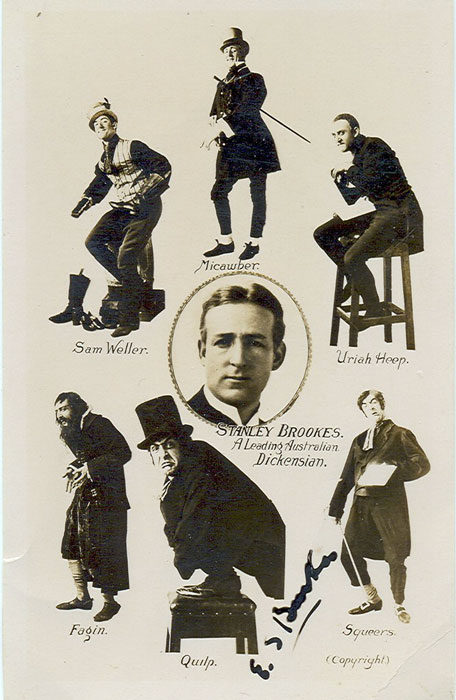
The pamphlet illustrates the story telling of a showman such as Edwin Stanley Stanley
Edwin Brooks was born Edwin Stanley Brookes ib 1889 Essendon, Mellbourne – died 1983 Windsor, Melbourne
A SKETCH OF THE CAREER OF OUR NEW LEADER
Knight Grand Cheese Fellow E. Stanley Brookes, although elected by a very substantial majority, feels that his professional and private life and activities are not sufficiently known to the fellows of the Club who have made him their leader, and that he considers Cheesers would have more confidence in him if they knew more of his back ground and achievements in his own country, Australia, and during his travels overseas. This Personal Sketch has been issued to the fellows of the Melbourne Bread and Cheese Club for that purpose.
E. Stanley Brookes, A.Eloc. M.S.V., former Melbourne University ex-Lecturer in Public Speaking; Hon. Professor of Speech, U.S.A.; acclaimed a World Celebrity Artist when appearing in U.S. University Course with World Celebrities Heifetz, Schnarbel, Rachmaninoff, and Myra Hess.
Born in Melbourne. His father. Professor F. A. Brookes, born in England, belonged to the Stanley Family, the Earls of Derby, the line created by Henry VII at the coronation in 1485. His mother came from Ireland. Both were artists and his father painted the portraits of the Governors of New Zealand. Fellow Stan is a big family pian. He has seven children, and all have done well for themselves – two reached the University through their own efforts and almost without cost.
THE BROOKES’ FAMILY FLAG
The Brookes family were pioneers of Albertland, Auckland, New Zealand. In the History of the Albertlanders of New Zealand, the Brookes family is one of two that has a chapter to itself. When the head of the family, the Rev. E. S. Brookes, left Nottingham, England, the ladies of the ancient ruling families made a flag, each family making a portion of it and bearing the Nottingham Coat of Arms in the centre. It was presented to the Brookes party to be flown at the masthead as the ship sailed from England. Pioneer Brookes paid the fares of about 50 settlers, on the Matilda Wattenbach, the ship they came out on. This historic family flag is now in Stan's possession, and he will eventually present it to the Albertland Pioneers Museum in Auckland, N.Z.
 |
| One Man in The Time Plays Many Parts - shakespeare |
At one time the family owned the Isle of Man and ruled over it as Kings. They issued their own coinage. The ‘Manx Penny,” 1723, bearing the family coat of arms, was one of their coins. He has one in his studio. They brought from England a church in sections, and also the first roofing slates. It still stands in Wharehine, North Auckland, N.Z.
Prof. Brookes was a world traveller, theatrical manager and lecturer. He managed and lectured at the Melbourne Cyclorama, and was one of the pioneers of the movies here. Stan was educated at a private C.of E. Grammar school, a State school, and privately tutored by Dr. Ocki at the University of Melbourne.
CIRCUS
Almost from infancy he was a natural acrobat on the high trapeze, a loose-wire walker without a balancing pole, and often appeared (unofficially) in visiting small circuses. He ran away with one, was soon hauled back and received a thrashing he will never forget. He almost worried the women (mothers) nearby to death. He lived in a terrace of eight house, and would run up and down the length of the ‘eight on the top of the paling fences without a pole, almost as quickly as he could run on the ground. They stopped him by putting barbed wire on the top of the fences. He often performed at the Saturday matinees on the trapeze and slack wire in the local circus.
MUSIC
At twelve he was the official instructor of the juvenile gym. class at St. Columb’s C.of E. Hawthorn, and was a choir boy there. He qualified as a chorister for St. Paul’s Cathedral, but because he was eleven, was told he was too old. Eventually he studied music at the Marshall Hall Conservatorium, which later became the Albert Street Conservatorium. Prof. Marshall Hall told him his singing was not good enough for the stage, so he became apprenticed to the printing industry with the Specialty Press. This crowd sacked him as soon as they could. Later, when Melba, heard him sing, all she said was, "Next please!"
PRINTER
Then "Herby” Green, a family relation, Victorian Government Printer and Interstate rowing champion of the Hawthorn Rowing Club, got him into the Government Printing Office, but Stan thinks Herby regretted it ever afterwards. Fellow P. Podmore was also a champion rower in the Hawthorn Club.
S.B. soon began to worry the life out of the night foreman “Bobba” Smith, the noted Collingwood footballer, by hanging by his toes from the hat racks on the walls and from any place high up where he could get a footing. He was also pleased when fellow Stan left. He simply could not get the circus blood out of his system, but it came in useful when he started performing Quilp the dwarf from Dickens, as he could reduce himself easily to a horrible creature 26 inches high, and in that posture hop on and off a kitchen table throughout the scene — so the circus served its purpose.
From his earliest years he was "mad on Dickens." Walter Bentley the famous Shakespearian actor suggested that he should study Dickens for the stage, and give readings from Dickens as Dickens did, but Stan said anyone could read although he had copies of the readings Dickens used himself. He studied under F. H. Booth, an English actor, and then under Fellow Howlett-Ross, who coached him for his speech degrees, and also as an elocutionary judge. He became the star pupil of Fellow Howlett.
SPORT
As a lad he was a training cox for the young rowers at the Hawthorn Rowing Club, but would not become a rower – after dragging the exhausted rowers out of the boats and turning the hose on them "to bring ’em to." It looked too much like hard work for him. He could swim a mile in the river, was a wretched cricketer, and a rotten footballer – he says, but was not too bad at lacrosse. He lost interest in football after the match when an opposing player laid him out with a picket from a nearby fence.
DICKENS ARTIST AND SPEECH JUDGE
When quite young he made a name as a Dickens artist, and almost his first public appearance was as a star in a special Dickens act in the pantomime of Dan Thomas at the Princess Theatre. He became a popular speech competition judge (thanks to Howlett-Ross) at the leading contests throughout Australia, Tasmania and New Zealand. Fellows Howlett and Stan were the favourite Australian judges of the New Zealanders, When Sir Arthur Stanley (later Earl Derby) was Governor of Victoria, he gave private entertainments there, thus uniting old family ties.
PIONEERING FIRST RADIO PLAY
Barely cut of his teens he was pioneering wireless at 3LO in 1923. He was the first non-technical radio pioneer in Victoria. Major “Wally" Condor (who later was appointed Governer of Pentridge) sent for him. "I want you to produce the first wireless play, he said to Stan. "I know nothing about these plays, replied Stan. "Neither does any other B~~~~! When can you have it on the air?" snapped the major. Fellow Brookes successfully produced the first Victorian wireless play on Saturday night, 21st March, 1925. It was followed by the World’s Wrestling Championship Elimination Contest, Walter Miller v. AI Karasik at the Stadium, described by Norman McCance.
At that period only two wireless stations were in Victoria, 3LO and 3AR. The A.B.C. had not even been thought of. He was attached to 3LO. Only about ten people were employed then, now there may be 150 or more. The stations were on the air only a few hours each day: morning 11 till 12: afternoons 3 to 5.15; evening 6 to 7.15 and night sessions 8 to 10.30. No band but the Buckley and Nunn Cafe Orchestra came at odd times to supply the music. 3LO was then at 193 Collins Street. Stan started broadcasting early in 1924.
RADIO PIONEER
He trained the first regular announcers; formulated the first guiding rules for announcers; laid down the first systems for Children's Broadcasts, the Bedtime Stories and the Children's Hour; conducted the first experiments in all sound effects for the plays and other broadcasts, and so on. He had to create everything himself as no broadcasting information came from overseas till long after he had completed his work at 3LO. Broadcasts were often very faulty. One day Stan and Mr. Stevens, the Engineer, bought two dozen double bed feather mattresses to cover the studio walls in an effort to stop the echos which were very annoying to listeners.
His most difficult job was producing the sounds for the effects because he soon found that sound effects used on the stage were useless for wireless purposes at that period. It took weeks of experimentation, even with the help of everyone in the station. Years later he broadcast his famous "Scenes from Dickens," his "One Man Plays,” in which he played all the characters, and the "Dickens School Broadcasts" from 3LO for the new A.B.C.
HE PLAYED NINE CHARACTERS IN A RADIO SESSION
When Geo. Sutton was manager of "Featuradio" Recording Co., Stan made some episodes of "Pickwick Papers” and played nine voices. Tom Holt, then manager of 3XY, said he thought six men played the parts as they were all so different. He phoned "Featuradio” to find Stan played all the nine voices.
Stanley Brookes was the first actor engaged re the voice experiments for the first Victorian Talkies as his voice was considered the perfect one for radio and recently he pioneered the first Australian film for TV. This was his noted "Scrooge" scene, filmed from HSV7, Xmas Day, 1957. It was from the studios of the new Meltzer film company. A few weeks ago he recorded the first "Horror" disc in Australia, but it was considered too horrible by the recording firm to put on the market. It may yet appear.
PHOTOS OF VOICES AND THOUGHTS
Many important wireless and radio newspaper articles came from his pen. In 1923 he was the only teacher in the English speaking world to teach radio speech, and is the only Australian speech teacher to study Voice Photography in foreign university speech clinics. Years before he went overseas he knew it was possible to diagnose certain diseases from photographs of the voice. For many years he has studied the photographing of thoughts and emotions, and this is proved by the photos he has of these things. Humorous Dickens Character Songs he wrote and composed years ago but has not published them; he invented Dickens Character Dances which he danced after performing his sketches; and when a youth he invented some character classical dances.
TIVOLI STAR, NEW ZEALAND
The names of Stanley Brookes, Stan Lawson and Joe Valli were the stars on the Tivoli in New Zealand in 1924. Lawson and Valli played leading parts in some of the famous Digger films Fellow Pat Hanna produced, and which arc Australian Digger classics.
SIR HENRY FIELDING DICKENS
In 1921 Sir Henry Fielding Dickens, K.C., the famous English barrister and then the only surviving son of Charles Dickens, wrote saying that the photos of Dickens characters made by Stan were among the best he had seen. These were presented to Sir Henry by W. A. Callaway, Under Secretary of Victoria and president of the Melbourne Dickens Fellowship.
SIR ARTHUR CONAN DOYLE
Sir Arthur Conan Doyle, a close friend of Stan’s, wrote him in 1924 asking him to ask Dickens to clear up the mystery of Dickens’ unfinished book, "The Mystery of Edwin Drood." Dickens told Stan that, "No author knows the end of a book when he starts to write it, and I did not know or consider how it would be concluded, as a book unfolds and develops often in a manner unthought of by the author." This letter is one of his prized relics. Lady Doyle invited S.B. to stay with them at their home in Sussex after his American tour. The first screen advertisements in Melbourne depicted him in the role of juvenile lead in scores of these film ads. He was the first teacher here to use gramophone discs, wire and tape recordings as an aid to his teaching methods.
CHAUTAUQUA
The credit for taking culture to our country districts must be given to an educational movement led by Sir Herbert Brookes, known as Chautauqua. It was originally an American cultural organisation established about 50 years ago in the U.S.A., which spread all over America and came to Victoria about 1920 – many years before the Adult Education and similar movements were established here. Fellow Stanley was one of the star artists who travelled over Australia, Tasmania and New Zealand with this Chautauqua association.
THE SPRINGVALE GRAVEYARD AFFAIR
Australians were thrilled when they read the newspaper's descriptions and big headlines about the man who slept all night Good Friday Eve, 1920, chained and handcuffed to a grave in the Springvale Cemetery. Our Stan was the one who did the job. Several of Melbourne's noted citizens took part in this unusual adventure. He did not know at the time it was a movie stunt to advertise a D. W. Griffith film in the Melbourne Town Hall, and also an attempt to discover if any ghosts would visit him during the night. He did not think they would because he did not believe that possible at that time. Bert Cross the noted movie cameraman took the Dim which was screened in the gazettes in every cinema. "Five pounds for a night out with the ghosts!" was its title. He jumped into pyjamas and slept in a camp bed placed on the grave of someone unknown. They had to break into the cemetery and the excitement of the night was getting two of the fat heavy theatre managers over the six feet high wire netting fence with barbed wire on top. Stan, clearly remembers the crude remarks of the managers. He told reporters it was the best night s sleep he had ever had – probably because he was paid five pounds to have it. Once he really "had the wind up” just before he went to sleep.
BURIED ALIVE AND CREMATION
Sometime during the night he either dreamt it, or it may have been a clairvoyant vision of an event that had actually happened there. However, he was looking into the grave of a man who had apparently been buried alive, because the person was making a most terrifying struggle to break out of the coffin. Strange to say, Stan did not remember this till exactly three months later. This started him investigating premature burial, and within a year he had discovered nearly 2,000 authenticated cases from all over the world of people being buried alive. Some were very well-known personages. Many who were saved from this most horrible death had terrible tales to tell, but on the other hand some had really funny stories to relate.
This strange graveyard experience interested him in cremation, and he and fellow Dr. W. A. Morrison with others were the founders of the first Cremation Society of Victoria, and they built the crematorium at Fawkner. At the opening ceremony Fellow Brookes was one of the speakers when he declared that cremation would prevent some people being buried alive. The Melbourne "Age” reported his speech which did not please the medicos. Sir Arthur Conan Doyle some years ago came here to lecture on spiritualism, and in his book on his tour he mentions Stan's Graveyard Affair, he also mentioned what happened in Tasmania.
When the film publicity folk found how easily S.B. went through his stunt here, they tried it out with a man in Tasmania, but they picked the wrong type. When they came for him in the morning he was almost crazy, declaring that during the night, a man dripping with water as though he had come straight out of the river nearby, gave our man a terrible time. It cost the film folk a big sum to send him away for a long holiday. Conan Doyle being a detective (the author of Sherlock Holmes) set to work, and he found that the grave on which the man slept was that of a man drowned in the river some years before. Sir Arthur and Stan agreed that the drowned person most likely resented his grave being used in the manner described. S.B. knows what it feels like to be buried alive. When a lad living in Middle Park Dr. Johnston of that district was the family doctor. After the 1918 War, during a sitting with the noted private trance medium, Mrs. Downing, of Middle Park, Dr. Johnston identified himself and began to speak through her. He told S.B. that as he would later on write on Premature Burial, it would be useful if he knew what this awful ordeal really meant.
The Dr. said he was an Anzac and had been blown up and buried alive in a shell hole. He knew he was dying and remained conscious to the last. He described his death to Stan from his feet up. Being a medical man he could relate the ceasing of the functioning of every organ in his body. When death through suffocation reached the brain, it could only be described as the exploding of a thousand cannons in his head – and this would be the process of death suffered by those buried alive in their graves. Recently Stan said, "I have a dread of being buried alive, so will take the precaution of having my jugular vein severed before they send me up in smoke."
WHEN HE WAS IN PENTRIDGE
"I have been in Pentridge several times – to entertain the men and women prisoners – until some silly clown tried to burn down their theatre. I suppose they thought I brought in the matches. No sooner did I poke by head in the theatre, when two of the prisoners snouted as loudly as they could, "Hullo Stan!"; and you can imagine how the boys enjoyed the joke when another voice yelled, "Back again Stan – what are you in this time for?” When he made the long walk through the 600 prisoners to the stage, the band struck tip, "Home Sweet Home." I made a few good friends in there, and one smuggled out to me a remarkably fine portrait of Monty, which I am proud to display in my studio.
THE BOTTLE OF BEER
"I am ashamed of the very little I did in the wars." he said. "During the First I was a relieving orderly at the Base Hospital at St. Kilda Road. I had to metho a digger every day who could not be operated on because he had a bullet in the spine. He was the only one in the hospital issued a bottle of beer a day. He would leave an inch of it so that the other twenty could wet their lips with It. When it lowered to the inch, they would all be at the ready by their beds – the cripples had a yard or two start' – to make a hell of a dash for the bottle as soon as it was held high in the air.
In the Second World War, with Phil Wade, well known shipping detective, they organised the first entertainments for the troops at the Showgrounds, "and a few other things not worth mentioning, he added. About 1939 he tried to enlist in the Entertainment Unit, and has never forgiven Capt. P ~~who turned him down. I could not tell what Tom Blarney had to say. Stan knew well the splendid lady Tom Blarney married.
"STAN IS QUITE CRAZY"
"Stan is quite crazy," said his wife when he told her he had ridden a horse in a torchlight parade. Just before the First War a torchlight procession was held in the city here for some patriotic appeal. He had never sat on a horse but he determined to ride one in this affair. He hired a frisky filly (he did not know this about the animal) from the milkman, who brought it into the city for him. The milkman did not know of course that Stan could not ride. He rode his mount up and down a lane near the starting point near the Trades Hall for fifteen minutes, then joined the procession. All went beautifully although a few pals said he was "not too firm in the saddle." He was riding behind a big float when it suddenly exploded with fireworks! The horse took fright and started to back right under the vehicle. Stan saw the position just in time to give the mount a mighty kick which sent the animal forward like a shot – and sent Stan sprawling on the tramtrack – fortunately still holding the reins and unhurt.
He quietly left the procession to recover his senses in a quiet alley off Flinders Lane, and in five minutes rejoined the procession. When his wife heard about it she said, "Stan is quite crazy — sleeping chained to a grave all night proved that!”
WRITER
During the period when he wrote for magazines he had many published, and when he was writing for L"ife" many were illustrated by Charles Nuttall.
"WORLD’S GREATEST DICKENS ARTIST”
"The World's Greatest Dickens Artist" – U.S. university. The American University and Education Authorities paid him the greatest compliment ever bestowed upon a Dickens artist. In 1934-5-6 they engaged him as "The World’s Greatest Dickens Platform Artist” to travel all over the U.S. to present Dickens and Australian lectures and entertainments in more than 600 schools, colleges and universities. Although his contract was for three only he often gave five a day, six days a week and sometimes on Sundays, lasting from one to one and a half hours each, and often travelling 1,000 miles a week. Many a time he did not go to bed owing to the all-night travelling.
After the first three months it almost killed him. When he left, at a dinner the Yanks gave him, they told him they "had discovered that the only way to kill an Australian was with an axe!" This tour created a world record. His work was considered so important that the U.S. Government granted his residence three times longer than the usual period, and he was often referred to as "The unofficial Goodwill Ambassador from Australia,” and advertised as "The Australian who had seen more of America than any other Britisher." His American manager has been waiting six years for him to sign a World Celebrity contract for his unique one-man three-hour shows, but ill health in his family circle will not permit his travelling abroad.
GREATEST FAREWELL CONCERT COMMITTEE
Fellow Brookes has the honour of having the biggest and most distinguished committee of Melbourne citizens ever assembled (50) to farewell an Australian artist the first time he went abroad. Fellows Dr. W. A. Morrison and Howlett-Ross were member of it. It was the first show in the New Imperial Theatre (now the Savoy) after its transformation from the old Temperance Hall.
DAVID COPPERFIELD FILM
On his way to America he was approached by radio regarding a leading part in the famous M.G.M. production of "David Copperfield,’’ but as he was under contract to the U.S. people, he was almost broken hearted when he had to let this life-long dream pass by. W. C. Fields played "Micawber".
HIS WORK IN THE U.S. SCHOOLS
The teacher-nuns in the R.C. educational institutions were among his greatest appreciators although he appeared before every type of group and society such as Craft, Rotarians, Kiwanis, Lions, Elks, Women's Clubs, and so on. Most American schools have their own perfectly equipped theatres (many finer and bigger than our best Australian theatres), some seating 5,000. He arrived at one college to find it destroyed by fire the night before, so he gave his full show from the 6x6 fire escape thirty feet from the ground. The roof and the walls alone of a High School in Minnesota cost 5.000,000 dollars and it had an English pipe organ that cost £10,000.
When playing "Scrooge" in one of the colleges he wen1 to sleep — he had not been to bed for two nights. The wild yells and laughter woke him up! When his work ended he studied short courses in the University Clinics in speech sciences. These are so advanced that a Doctor of Speech Arts and Science Degree is obtainable. Every big school has its full-time Professor of Speech and Music. If he could have accepted all the Speech Training Professorships the U.S. Universities offered him, he would have become a "Millionaire" in record time.
A CHARLES DICKENS LETTER
At the University of Hawaii he acquired a letter written by Charles Dickens in Kent, October, 1855. The signature is a work of art. It has been exhibited in the Melbourne Public Library. It has pride of place of course in his studio.
THE ONLY AUSTRALIAN RED INDIAN CHIEF
At Poplar, Montanna, 1935, S.B. on the Indian Reservation, was created the only Australian Red Indian Chief. In their Round House in the presence of 300 Indians, their squaws children and 50 Chiefs, and the U.S. Indian Agent Supt. Hunter, he was Initiated with full ceremonial into the Sioux Tribe, and given the title of Chief Red Bear.
This was to honour the memory of his father because he had been a friend, interpreter and peacemaker re the Sioux Tribes in that and other States. Prior to that period he was an Indian Scout under Buffalo Bill, and they were lifelong friends till the death of Cody in 1917. Stan lived as a Redskin with his tribe for a few days, and this deepened his great admiration for them.
BUFFALO BILL
S.B. wrote many articles on Buffalo Bill from his father's personal memories of Cody before he went abroad, but in the U.S. he was presented with "The Life of Buffalo Bill" written by himself, and another life story written by his sister. He was a lineal descendant of Milesius, King of Spain, whose three sons founded the first dynasty in Ireland, therefore he comes down from the Kings of Ireland. His official title was The Hon. William F. Cody, J.P., Chief Army Scout and Legislature Representative of the State of Nebraska. He was a truly great man, but space will not permit what Stan would like to write about him.
EARLY AMERICAN TV EXPERIMENTS
In 1934 he participated in T.V. experiments from the Empire State Building (a quarter of a mile high) in New York, and in Chicago. He stood in front of a dished picture frame 4 feet square with a foot opening in the centre. The images were projected through this opening onto a movie screen 300 feet away. Every few seconds he caught a faint glimpse of himself through a heavy shower of rain – that is the best description –and that was TV in 1934. The only lighting came from eight globes – two sunk into each of the four sides of the 18in. wide picture frame.
WORLD'S BIGGEST MUSIC FESTIVAL
About this time in the Soldiers’ Field Stadium in Chicago he sat with the adjudicators when they judged 10,000 musicians at the one time before an audience of more than 100,000.
HYPNOTISED BY GRAMOPHONES
From there he went to a hospital clinic where he found patients undergoing minor operations after being hypnotised by the playing of a gramophone. Unknown to the patient he took the place of the gramophone and put the man to sleep while he had a finger nail removed.
THE COLOUR OF MUSIC. THE COLOUR ORGAN AND COLOUR FOUNTAIN
As a student of music from the Occult aspect, he was interested in seeing demonstrated the theory that every musical tone has its own colour and character. At the Chicago World’s Fair he heard the Detroit Symphony Orchestra play from a big float on the lake. The music was wired to a mixing room half a mile away where the musical vibrations were transformed into light (colour) vibrations and flooded over three fountains seventy feet high. The result was that as the notes of music continually changed so did their corresponding colours change, thus throwing into the fountain an ever-changing symphony of colour.
Out in the West this principle was proved again by the Colour Organ. In a long dance hall with a convex shaped ceiling (the whole place was white) resembling a huge tunnel, the organist by throwing a switch, turned off the normal lighting, and the entire place was filled with ever-changing colours which had been transformed from the music by the organ.
THE COLOUR CURES IN HOSPITAL
He discovered that colour was used extensively in the treatment of nervous patients in some hospital clinics. For instance, a nervously depleted person needing mental stimulation, was placed in a room where everything was red, and a patient requiring a soothing treatment, would find himself in a blue room. Other colours, and colour combinations were used for various purposes.
A UNIQUE ARTIST
Stanley Brookes is the only artist in the world who gives entirely from memory an entertainment covering three hours alone. He always creates a thrill when he performs Quilp the dwarf only 26 inches high by hopping on and off a table like a frog. He still performs. (Some blokes never grow up).
RIPLEY
Ripley of “Believe It or Not” fame invited him to see some of his ’’Human Freaks.” “Singhlee” bent a one-inch thick red hot iron bar with his teeth, and blows the fierce flame from a blow-lamp into his mouth and eyes, and he saw the Lord's Prayer written in full on a grain of rice under a magnifying glass – and many other “Human Marvels.” Paul Schollkopf, a Yogi, nails himself to a board by hammering a thick nail through his tongue to a table. He never bleeds – even when stabbed.
PRESIDENT ROOSEVELT
Arrangements were almost completed for Stan to entertain the President at Xmas with his "Scrooge” scene from Dickens, when the President's secretary wrote that Mr. Roosevelt had to go to Florida. He visited the White House but did not meet the President. A great disappointment.
A PUBLIC EXECUTION
Fellow Brookes is the only Australian who has seen a public hanging in the U.S. A crowd of 1,500, a third of them WOMEN, crowded into the courtyard at Smithfield, Kentucky, 21st April, 1935,to see William Be Boe hanged from the gallows for assaulting a woman. They heard him argue with his accuser, Mrs. Marjorie Johnson, for half an hour before he was plunged Into Eternity. Prior to the hanging the crowd were entertained by watching the officials test the rope with a bag of sand exactly the weight of the condemned man. As soon as the black cap was put on, Stanley left. He had more than enough. The photos of the whole affair were sent him the next day. He heard the crowd saying it was a political job.
THRILLING SNAKE DANCE OF THE REDSKINS
These Snake Men dance with deadly rattlesnakes in the mouth. It was horrible. This is a Prayer for Rain and is put on when a drought strikes their country.
PERFORMING IN A MINE THEATRETTE
A few days after being at the top of the world's tallest building, he was entertaining the miners in their hall 500 feet below the surface. A giant Studebaker care seating -80 comfortably, was used at the Fair in Chicago, as a movie theatre.
THE KU KLUX KLAN
One night he was taken to see the terrifying Flaming Cross Ceremony of the Ku Klux Klan. The Second Klan was originally a decent organisation, but it developed into unorganised groups of gangsters.
GENERAL McARTHUR
The Redskins of America considered that General McArthur was the greatest American Warrior, and consequently in 1942 they conferred the highest honour upon him by making him Sioux Chief Standing Grizzly Bear, Supreme Chief of all the American Red Indians. As fellow Stan had been made a Sioux Chief also some years before, he suggested that the General might consider being photographed in the genuine Sioux War Bonnet presented to Stan. The General informed him that he had received his War Bonnet from his Sioux brothers in Montana, and that "He is very pleased indeed to learn that there is another Indian Chief besides himself in Australia.” (June, 1942).
PUBLIC LECTURES TO VICTORIAN TEACHERS
Realising the importance of the knowledge gained by S.B. concerning American Education, the Assembly Hall was engaged for him to lecture to the teachers on the latest developments of American education soon after his return, and many of the ideas he brought from U.S.A. were adopted. One was the exchange of teachers and students which he suggested 23 years ago.
AN INTERNATIONAL PERSONAGE IN PSYCHIC AND OCCULT RESEARCH
E. Stanley Brookes has an internation reputation in the fields of Psychic, Occult and Spiritualist Scientific Research today, and has the distinction of being the only Victorian listed in the “International Who's Who of Occult and Psychic Science.” He produced the First Public Trance Lecture in Australia at Queen's Hall, Melbourne, 1936. It had to be repeated. He is President of the Spirit Rescue Circle, which is the only one of its kind in the world, as it is entirely controlled and managed by his spirit friends in the Beyond. All the power used by the medium during the seances (sometimes he has to interview murderers and roughnecks) is supplied by 49 spirit friends and scientists-power which is always supplied by human sitters at all other seances. The only living people taking part in this particular circle, is the medium, the secretary, and E.S.B., who manages and supervises the tape recorder, as all the interviews with the spirit folk are taped for the records. Fellow Stan corresponds with psychic scientists and researchers in many parts of the world, exchanging reports, and he writes on these subjects for English and foreign journals, as he is considered an outstanding authority.
LORD DOWNING
He corresponds on this subject with Lord Downing the hero of the Battle for Britain, who was helped write its history by fliers under his command in the battle, coming to him after they had been killed – to tell Downing how and where they died, and often giving details of secret operations.
LORD RUSSEL OF LIVERPOOL
Stan also corresponds on this subject with Lord Russell who was a judge at the German War Crimes trials. He wrote, The Scrouge of the Swastika” and recently, "The Knights of Bushido (Jap. War Crimes), and has told Stan he is writing a History of the Jews. Lord Russell has asked Stan for the full details of his interviews with the dead Heydrich and Hoss, two of the worst German War Criminals, when he spoke with them last year. He was brought up in a religious orthodox atmosphere! Delving into Spiritualism and kindred subjects was the last thing he thought of doing, but Fate or Destiny changed his life from the moment he slept on the grave at Springvale many years ago, and he is now doing a job he finds he has to do.
MY 4000 GHOSTS!
Charles Dickens, Conan Doyle, Gandhi, Wdliam Crookes, Will Rodgers, Buffalo Bill, Father Francis, Rabbi Jacobs, Hugh D. Mclntcsh, Lord Shaftesbury, Earl of Derby Lord Chief Justice of England Baron Trevethin, and literally hundreds of others in the Beyond, who are helping Stan compile a book which they say will be the most compelling concerning the everyday life of the so-called "dead” in the Life After Death. It will consist chiefly of his interviews and discussions he had t*ad with more than 4000 spirit entities during his years of psychic research.
THE COMING CHANGE IN ANZAC DAY
Fellow Brookes is the one who started the appeal for brighter Anzac Day immediately following our First Anzac Day. He did so at the urgent request of Jack Reynolds of Sydney, and many other diggers killed on Gallipoli, who explained. that the excessive public mourning was detrimental to them, as it bound so many of them to the earth and prevented their spiritual progress.
THE ANZAC NIGHT SHOW AT WIRTHS
He with others lest money year after year by producing shows on Anzac Nights to provide a few happy hours for those who had no place to go and were forced to walk the dead streets of Melbourne. His battle with a small group in the R.S.L. (who had their own clubs to have a good time in), is well known. However, he knows that in a year or two this State will come into line with other States by observing the day as they do – in a more cheerful, sensible and beneficial manner’ to. distressed diggers, widows and orphans.
PRESIDENT AND LEADER OF MANY SOCIETIES
Because of his well known and various activities, and perhaps because of his fearlessness in attacking Individuals, customs and institutions which are opposed to the public welfare, he is one of Australia's best known citizens. He has challenged many public personages to public debates on matters of public importance, but so far none have crossed swords with him.
He is or has been connected with most literary and similar groups here and several overseas, and is president or has been of the Players and Playgoers Association; the Society of Psychic and Occult Scientific Research; the Folklore Researchers; Psychic Rescue Circle; Speech Science Society; Planetary Research; Vice-President of Melbourne Dickens Fellowship; Early Australian Convict and Immigration Study Society; Students of Aust. Theatrical History; Capital Punishment Researchers; Ghost Lore Collectors; the Antiquarian and Old Print Lovers .Society; etc., etc., and he is a lover of Art in all its true forms.
SIR ARTHUR CONAN DOYLE BROADCASTS FROM MELBOURNE
Sir. Arthur Conan Doyle, the famous creator of "Sherlock Holmes (died 1930), made radio history by broadcasting twice from 3AW Melbourne, July, 1952. Fellow Brookes arranged this remarkable spirit broadcast, but it was suggested and organised by his spirit friend Edgar Tozer, formerly a well known Melbourne business man. This was the first and only time Sir Arthur had broadcast since his death, and it was the only time a spirit voice has broadcast from an Australian radio station. The seance took place in Stan's Melbourne studio, 6th July, 1952, and extracts were put on the air by 3AW at 1.15 and 8.30, July 24. Sitting in the seance with Stan were H. Thompson, Publicity Manager; Rex Walden, Announcer; and Miss J. Darling, short-hand writer – all representing 3AW. L. Richard, photographer and Royce Ferguson and Mr. Callander, tape recorded the whole proceedings, which lasted an hour and a half. Sir Arthur's full speech will be published in Fellow Stan’s book. He gave little known facts of his private and public life, "Sherlock Holmes," sporting, Spiritualistic, authorship, and his life as a doctor. He said he was paid 10/- a word for his short stories – a world record. He also cleared up the mystery about Harry Houdini, whom he knew very well.
DICKENS PERFORMS A MIRACLE IN MELBOURNE
Stanley Brooks became internationally famous as a Dickens artist because Dickens has been inspiring and helping him for many years, but he did not know. this until a few years ago. He has the wonderful pleasure of talking with Dickens about once a month all the year round through his medium, Madam Florence. All his sittings (conversations) are tape-recorded and he has played some of them in public. He arranged his one-man three-hour show in the Assembly Hall, Melbourne, 9th November, 1953, and with the assistance of Dickens, selected his programme. Three days before his show he woke up to find he could not speak. Terrified, he arranged a short seance with his medium to ask Dicken’s advice. Dickens told him he did not have an ounce of energy left because he had slaved for two months to make his show a success, and that medical science could not now recover his lost voice. "We will give you a voice for three hours," said Dickens. S.B.: "What do you mean by ‘we’?” Dickens: "You are giving your concert (free of cost in aid of the mentally afflicted and the spastic children are you not?" S.B.: "Yes."’ Dickens; “Well, so pleased are the people over here who were mental and spastic when on the earth, that this is their way of proving their appreciation of your efforts – they will hold the power for you that you will subconsciously draw upon when on the stage for three hours, but, after that we cannot say what will happen, but to go through your programme is your greatest concern – is it not?" He then asked Fellow Stan to go home and stay there for three days, and not talk under any circumstances, also, to ask his wife to fill him with all the nourishment possible, and to rest till just before the show. Only his manager Faulkner Smith, his medium, and his family knew of his tragic loss of voice; the house had been booked out, and the show had to go on. "Half an hour before the show,” Stan says; "the voice began to come back, and by eight It was almost normal. It was the hardest, most complicated, and longest show of my life; yet it was as easy as falling off a log. I do not remember anything about it, other than commencing and concluding. My spirit friends must have hypnotised me so that I could draw upon my subconscious memory throughout; I did not miss a word or make a slip. I did nothing – they simply carried me – and that was that, but I never cease to thank Dickens and his spirit helpers for saving me from a theatrical tragedy.
Half an hour after the show, my voice completely disappeared, and it was fully eight weeks before it resumed its normality. Several remarked that my voice seemed strange" – when they read' this – they will understand why!”
Return to Federick Brookes main page
|