Gael Newton AM, 2009
The first photographic portraits in the 1840s were small, dark images on metal plates called ‘daguerreotypes’ after their French inventor, Louis Daguerre. In the first few years only the more affluent classes could afford daguerreotypes.
But by comparison with the cost of a commission to a painter or draughtsman, photographic portraits were cheap and quick to make. By 1850 further technical improvements in processing plus mass production of cases, cameras and accessories made the process even quicker and cheaper. By the mid 1850s a wide range of middle class sitters across the world could have a very high quality image of themselves and their loved ones. At first the photographers travelled out from Europe and North America out along the regional and international trade routes capitalising on the lack of local competition..
The new photographic portraits were also remarkably accurate ‘likenesses’ as they were known, even the subjects ended up looking very grave due to the minutes of exposure with head held in a clamps, needed for each sitting. French history painter Paul Delaroche is reputed to have declared that ‘From today painting is dead’ and the new medium did more or less end the craft of miniature painted portraits.
Many artists experimented with photography on metal and on paper and paid attention to the style and scope of the new medium. Transported convict artist Thomas Bock in Hobart was the first in Australia to establish a successful commercial studio for photographic portraits. He first advertised in the Hobart Town Advertiser of 29 September 1843 that 'in a short time he would be enabled to take photographic likenesses in the first style of the art'.
This was in direct competition with George Goodman, a professional photographer from London who had arrived in Sydney in 1841 claiming to have an exclusive license to operate in the colonies. Goodman was working in Hobart and Launceston from August 1843 to January 1844 and threatened legal action against colonial upstarts. Bock promptly stopped advertising but opened a portrait photography studio in Hobart five years later. He was aided by his step son Alfred Bock who continued the business after his father’s death in 1855.
Bock was apparently inspired by seeing daguerreotypes from London owned by Bishop Nixon in Hobart, who also later became an amateur photographer. Thomas and Alfred were self taught; they read about photographic formulae published in the English magazine, the Athenaeum of July 1841 and from recipes from British photographer Robert Hunt's 1841 photographic manual.
Evidently Bock took some time to acquire technical skills for Hobart dignitary G.T.Y. B. Boyes between recorded his visits to Bock's studios for daguerreotype portraits in late 1849 -1853 but mostly complained that 'Bock understands the nature of his apparatus but very imperfectly!’.
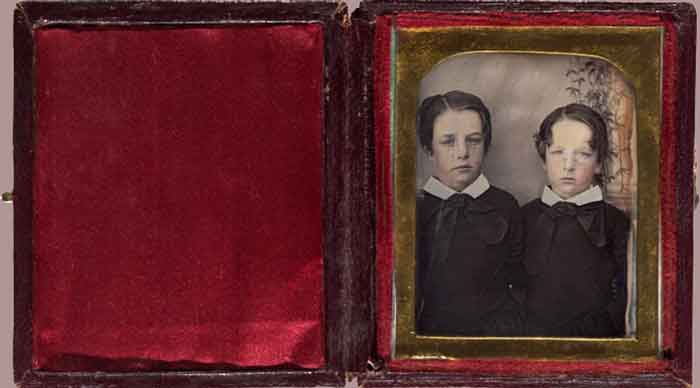
The image of the two boys above, shows that Bock was a skilled professional photographer by 1848.
more about Thomas Bock
Essays by Gael Newton AM