Thomas Bock (1790–1855)
Australian (Hobart) artist - photographer
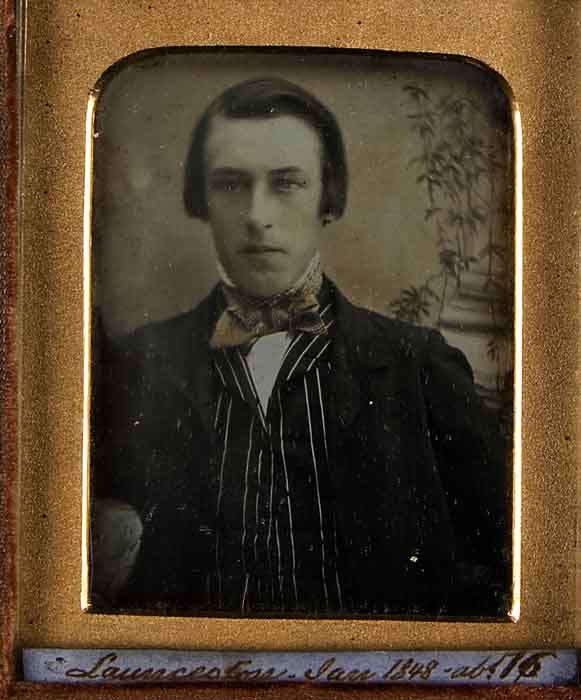 |
Thomas Bock 1848, unidentifed man Launceston
Collection PowerHouse Museum Sydney |
Thomas Bock was an English-born engraver, painter, and photographer. In Hobart 1824-1855 Bock was one of the country's first professional portraitists and an early pioneer of Australian photography.
Before his exile, Bock was an accomplished engraver and miniature painter in Birmingham, England, even winning a silver medal from the Society of Arts in 1817. However, in 1823, he was found guilty of administering drugs to his young mistress to induce a miscarriage. He was sentenced to 14 years of transportation and arrived in Hobart Town (then Van Diemen’s Land) in January 1824.
The colonial authorities recognized his immense drafting skills right away. His earliest assignments included engraving the first banknotes for the Bank of Van Diemen's Land - and - creating sketches of executed criminals for the Colonial Surgeon—including a notorious post-mortem sketch of the cannibal bushranger Alexander Pearce.
Bock received a conditional pardon in 1832 and a full pardon in 1833. He quickly established a commercial gallery and studio, first on Liverpool Street and later at 22 Campbell Street, Hobart. He became the premier portraitist for Hobart’s wealthy elite and political figures. While he worked in oils and watercolors, he was most famous for his "French crayon" (pastel and chalk) drawings, which contemporaries noted captured the true character and psychology of his sitters rather than just a stiff likeness.
Between 1832 and 1835, Bock was commissioned by Lady Jane Franklin (wife of the Lieutenant-Governor) and G.A. Robinson to paint a series of portraits of Tasmanian Aboriginal people, including Truganini and Mannalargenna. These detailed watercolor portraits remain incredibly significant historic and ethnographic records, capturing the community before deep colonial displacement altered their traditional dress and appearance.
Bock's inclusion in the history of photography comes from his work with daguerreotypes—the earliest publicly available photographic process. As early as October 1843, Bock advertised his intention to take daguerreotypes in Hobart. This briefly caused a legal dispute with George Baron Goodman, who held the exclusive commercial license for the process in Australia at the time. Despite the delay, by the late 1840s, Bock had successfully integrated photography into his Campbell Street studio business.
Most surviving daguerreotypes by Bock feature unique painted studio backdrops, frequently featuring a characteristic trailing piece of ivy. Bock died in Hobart in March 1855. Because he didn't die a wealthy man, the Hobart art community organized an exhibition of his work shortly after his death to raise funds for his widow and family.
His stepson, Alfred Bock, took over the Campbell Street studio and went on to become a notable Australian photographer and painter in his own right.
No Portrait of Thomas Bock
There is no confirmed portrait of Thomas Bock. This despite bock being Hobart's most prolific and successful colonial portraitist. He painted hundreds of faces ranging from wealthy settlers to Tasmanian Aboriginal people,but there are no known self-portraits in oil, watercolor, sketch, or daguerreotype form.
A few reasons help explain why we don't know what he looked like:
Early in his colonial career, Bock was working under the constraints of a convict sentence. He painted what he was ordered to paint (like bank notes or sketches of executed criminals), and later painted to survive.
Once he became a free man and opened his Campbell Street studio, his work was entirely client-driven. He made his living capturing the vanity and status of Hobart's upper class, who paid handsomely for his "French crayon" drawings.
Painting himself may have simply been a luxury or a commercial distraction he didn't prioritize.
A massive portion of Bock's lifelong output remains lost, undocumented, or sitting in private family collections with the sitters listed as "Unidentified Gentleman." It is entirely possible he did sketch himself, but the piece has either degraded or remains unrecognized in a private home.
There are portraits of his family members and the close circle around him. His stepson and apprentice, Alfred Bock, went on to become an incredibly accomplished artist and photographer in Hobart, leaving behind multiple clear photographs and portraits of himself.
Thomas Bock, two Boys 1848 daguerreotype
Review by Laura Cumming, Thomas Bock 2017 exhibition at Ikon Gallery, Birmingham
photo-web contents page