|
Margaret Benyon
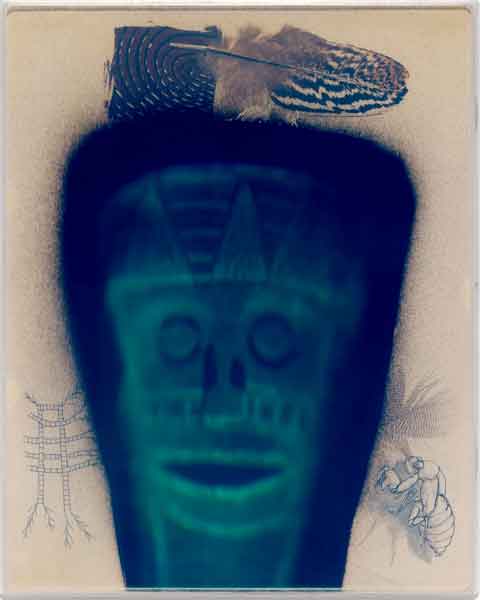 |
Margaret Benyon, Totem 1979,
collection National Gallery of Australia (Canberra) |
Margaret Benyon (1940–2016) was a groundbreaking British artist widely recognized as "the mother of British holography." She was the first artist in the UK to directly use holography—the practice of using lasers to record three-dimensional light patterns—as a fine art medium, taking it out of strict scientific laboratories and into art galleries.
Originally trained as a painter at the Slade School of Fine Art in London, Benyon became fascinated by optical illusions and spatial depth. In 1968, she secured a fellowship at the University of Nottingham, gaining rare access to a mechanical engineering lab where she taught herself the complex physics required to make holograms.
Benyon’s artistic career with holography is generally divided into distinct phases:
1968–1973: She focused entirely on exploring the unique attributes of the medium, culminating in 1969 in what is widely considered the world’s first solo exhibition of art holography.
Late 1970s: She moved to Australia, working under research fellowships at the Australian National University (ANU) in Canberra and collaborating with the CSIRO in Sydney. Immersed in the landscape, her holograms evolved into more cross-cultural, humanist, and socio-political mixed-media pieces.
1981–1993: Returning to the UK, she set up a private, low-tech studio in a converted garage in Dorset. She partnered with scientists to use high-speed pulsed lasers, allowing her to safely capture live human subjects. During this phase, she focused entirely on the human form and a distinctly female aesthetic.
Example of major works:
"Tigirl" (1985) Her most seminal piece blends a pulsed holographic self-portrait of the artist with a photographic print of a tiger. When viewed dead-on, the lines formed by the laser exposure align perfectly with the tiger's stripes. If the viewer steps to the side, the holographic image vanishes, leaving only the image of the tiger.
The Cosmetic Series: A body of work where she overlaid holographic portraits directly onto underpainted, heavily "made-up" images of her subjects, exploring identity and surface appearance.
"Counting the Beats" (1981): A collaboration with physicist John Webster using double exposures fractions of a second apart. The resulting interference lines across the figures provided a literal visual readout of micro-movements, showing one head nodding "yes" while the other shook "no."
Benyon proved that lasers and complex wave optics could be handled intuitively by an artist. In 1994, she earned a PhD from the Royal College of Art for her thesis How is Holography Art?, and in 2000 she was awarded an MBE (Member of the Order of the British Empire) for her pioneering services to art.
She returned to Australia in 2005, teaching at the University of New South Wales (UNSW) before her passing in 2016.
Her pieces are held in institutions such as the Victoria and Albert Museum in London and the National Gallery of Australia.
Margaret Banyon: Born Birmingham, United Kingdom, 1940 – died Sydney, Australia, 2016
Essay by Gael Newton: Pushing up the daisies, 1996
Wikipedia entry on Margaret Benyon
HolCentre (UK) entry on Margaret Benyon
Global Images Hologram Art Collection entry on Margaret Benyon
Jonathan Ross Hologram Collection: Margaret Benyon
Return to photoweb table of contents
Gael Newton essays
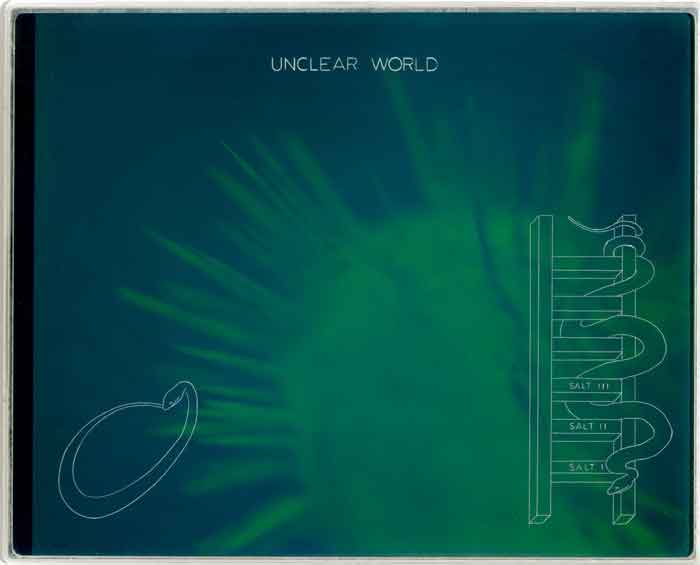 |
Margaret Benyon, Unclear World 1 1979,
collection National Gallery of Australia (Canberra) |
|