|
Margaret Benyon
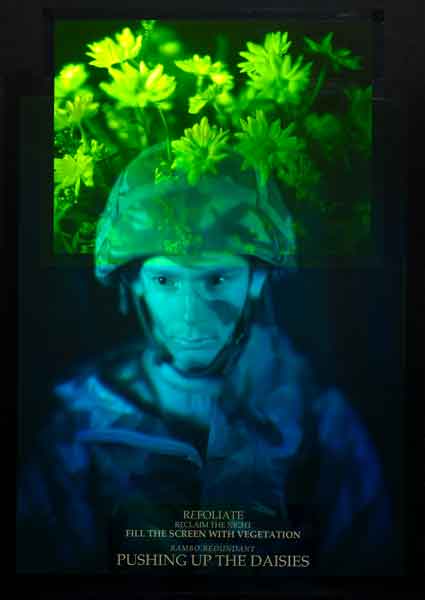 |
Margaret Benyon, Pushing up the daisies 1996,
collection National Gallery of Australia
The work was made using the facility of the Holography Unit,
Royal College of Art, London and Artist’s Holography Studio, Dorset, UK |
Gael Newton AM, 2009
In the late 1960s, British painter Margaret Benyon, who had been working with moiré effects in her Op art abstract paintings, became one of the first artists to see the creative possibilities of holograms. At the time, these were being constructed in just a few advanced scientific labs. The new medium opened up interesting possibilities for Benyon to explore modern technology and her ideas about time and space, and to express personal spiritual and social perceptions.
What is not well known is the role Benyon’s years in Australia from 1977 to 1981, played in the development of her work. During this period she had fellowships at the Australian National University in Canberra worked as Coordinator, Graphic Investigation at the Canberra School of Art, and was able to create holograms using the facilities at the university in Canberra and at the CSIRO in Sydney.
Particularly important at this time too was Benyon’s introduction through the resources at the Australian National University and the Aboriginal Studies Institute to Indigenous Australian art and culture. Many artists in the seventies developed social and political concerns, especially in regard to nuclear threat and environmental pollution.
Her experiences in Australia and general sense of the wider issues, influenced Benyon’s move away from abstraction and the appearance of cross-cultural, social and political references in her hologram works.
In 1979 and 1981 respectively, the National Gallery of Australia acquired Hot air, Benyon’s laser-transmission hologram of 1970, and her Australian-made reflection hologram Binding 1979, a subtle work of lines and twigs.
Thirty years on Benyon’s return to live in Australia in 2005 has facilitated the acquisition of four works from the artist’s Australian period: Totem, which references Indigenous Australian’s understanding of land and culture; Lattice II, which showed Benyon’s continuing interest in abstract web-grids; Greenhouse I: creation myths and Unclear world, which are both steeped in the big picture of ecological and nuclear threats.
In addition, Pushing up the daisies a major large-scale hologram montage from 1996, was selected to represent Benyon’s later career. The latter like many of Benyon’s titles, plays on words and associations; ‘pushing up the daisies’, meaning to be dead and buried, was a euphemism popularised during the First World War and also used by doomed British war poet, Wilfred Owen.
In Pushing up the daisies, fresh daisies literally sprout from the head of a sad soldier dressed in modern camouflage gear and bathed in the eerie artificial light of 1990s high tech warfare. At the bottom, in a staccato cascade of different-sized fonts is what amounts to a poem by the artist;
Refoliate
Reclaim the night
Fill the screen with vegetation
Rambo redundant
Pushing up the daisies
Replaced by technologies, even the old fashioned honour and glory of the soldier in warfare has been made redundant. It is ‘pushing up the daisies’. The state of war has become inhuman, if it ever was (movies tell us it was). Either way, something has died (or is going to).
Return to Margaret Benyon main page
|