The context of Re-constructed Vision : related texts
Photoworks 1965-1982: beyond the traditional use of photography
1985 exhibition catalogue, Australian National Gallery
University Drill Hall Gallery (Canberra) 19 September to 17 November 1985
Text by Grazia Gunn
The works on view in this exhibition illustrate the freedom of aesthetic thinking that was a characteristic of the art of the 1970s. Each artist expresses different visual and intellectual propositions and the only common thread in these works is the emphasis on the photographic image as a medium. The artists represented here have not used the camera as a tool for precise photographic reproduction, but rather as another medium with which to experiment in the plastic arts. The result has been a redefinition of the traditional parameters of photography.
In some of these photographs unusual photographic methods have been used to comment on modern society; in others, the artists are concerned with the meaning of language and their work extends the concept of visual semantics. By contrast, there are a number of photoworks included here which do not refer to external agents but rather assert the artists’ preoccupation with the self as subject matter. These different orientations and concerns project a variety of artistic sensibilities.
|
|
| Victor Burgin, Patriarchitecture 1977, gelatin silver photograph |
Christo, Wrapped coast, Little Bay, 1969,
silver gelatin photograph by Skunk-Kender |
In the early 1960s photography was used to record Happenings. The concept of the Happening, according to which events themselves could become art forms, introduced the idea of art as an experience rather than as an object to be acquired. Performance art followed on from Happenings and further reinforced the notion of art that could not be for sale. Performances were also documented by photographs.
By the late 1960s conceptual artists were using photography in a way that made no reference to its previous uses and technological functions. Art was identified as being idea, knowledge and information, and was documented with photographs, films and video-tapes. The Land-art artists of the 1970s used similar methods to document their works, which were usually temporary structures or ephemeral events that had been set up in remote areas of the landscape.
For some artists of the 1960s, particularly those involved in the art forms classified as Happenings and Performances, the role of the photograph was primarily one of recording and documenting. In retrospect, the photograph, as the only testament to a specific art event, becomes a substitute for that work of art or the principle it upheld. The photograph not only captured actual moments from ephemeral events, but also gave documentary form to the artists’ ideas and propositions.
Some of the photoworks seen here, however, are not purely documentary in nature but are in fact early examples of an aesthetic which continues to inform contemporary art. These photoworks illustrate the introduction of photography as a surrogate art work.
The majority of the photoworks exhibited have links with Performance, Conceptual and Land art. Nevertheless, a close analysis of each artist’s intentions will suggest that there are as many deviations and oppositions within each classification as there are links and parallels. This exhibition offers, then, a visual dialogue of contrasts and parallels, a few of which are examined below.
Conceptual art affords a convenient starting-point for a discussion of photoworks produced over the past two decades. Joseph Kosuth was one of the first artists in the 1960s to use photography as a component of the work rather than as a record of it. The photowork in this exhibition follows Kosuth's series One and Three, which he produced in the mid-1960s. The series used three codes of communication: the actual, the pictorial or representational, and the written. Thus, in One and three mirrors, 1965, the viewer is presented with three panels: an unframed mirror, a photograph of the same mirror in situ and a dictionary definition of a mirror. Each of these three codes communicates the concept of ‘mirror’.
|
|
| Richard Long, Stone in Morocco, 1969, silver gelatin photograph |
Jan Dibbets, Comet horizon 6°-72° Sky/sea/sky, 1973
12 type C photographs and decal lettering |
Another artist who comments on codes of communication is Jan Dibbets. Dibbets’ photoworks are primarily concerned with the difference between the mind’s perception of three-dimensional reality and a two-dimensional photographic copy of that reality. In Comet horizon 6°-72° sky/sea/sky 1973, the artist has made twelve photographs of a horizon. The horizon, traditionally depicted as a horizontal line, here curves across the wall in a comet shape.
Land-art artists integrate art and the environment, and the works are specific to the location in which they are created. Having installed the work, the artist leaves it to be eroded, so that what is produced is always a transient art form. In general, earthworks involve elements in nature that have ritual associations, and this focus is particularly evident in the works of Richard Long. Moreover, the aura of transience in Long’s photographs draws attention to the concepts inherent in his projects.
The same may be said of a number of other Land-art artists who install rudimentary structures in inaccessible parts of the landscape, not as consumable or marketable art objects, but as symbols of transience. In time, then, the photograph becomes the only record of the idea.
Another artist working in the landscape, but on a different scale, is Christo. He is best known for his Land-art projects such as Wrapped coast Little Bay 1969, Valley curtain 1971, and Running fence 1976, but the visual effects of these projects are only one aspect of the artist’s activities. Almost more important to him than the finished piece is the process of planning and executing a project: fundraising, lobbying for support, negotiating with Government agencies and individual land-owners, and working with a large number of skilled and unskilled people. Christo allows others to photograph and film his large projects. In Packed coast project for Australia, near Sydney, 1969, he presents the concept before it is actually realized. Works of this kind function both as studies for the project and, when sold, serve as certificates of their purchasers’ financial support for it.
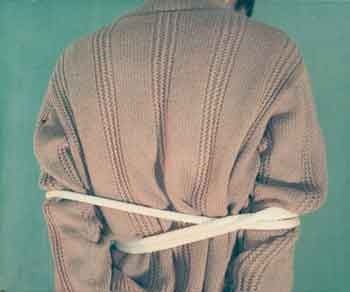
Of a different intellectual orientation are the works of Bruce Nauman, who, in the late 1960s, produced a number of photoworks that commented on the colloquial use of the English language, while at the same time making ironic reference to the creative plight of the artist. For Feet of clay 1966-70, Nauman literally placed his feet in clay and photographed them. Likewise for Bound to fail 1967, he photographed himself bound with a rope.
|
| Giovanni Anselmo, Entering my own work, 1971. Silevr gelatin photograph on photosensitized canvas |
In Entering into my own work, 1971, Giovanni Anselmo makes similarly ironic reference to a figure of speech, that of the Expressionist artist’s idea of being ‘in the work’. Anselmo’s wit is aimed at the formalist doctrines of abstract art. His large canvas is not a field of paint, but literally a photograph of a field. The idea of artists entering their works is rendered literally: Anselmo set his camera on a delay mechanism, pointing at a field, and then ran into it.
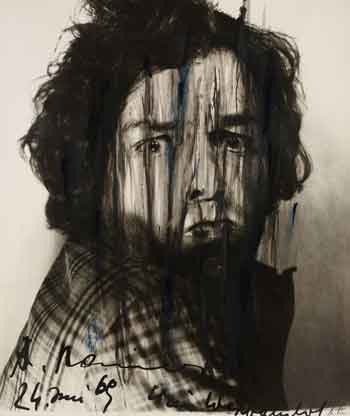
Private tableaux have been set up for the camera in the photoworks of Arnulf Rainer, Lucas Samaras and Cindy Sherman. The earliest Rainer photograph in this exhibition, Blaustern 1969, is a self-portrait posed in a traditional portrait style. The angst of the artist is then expressed through the use of wild strokes of crayon drawn over the photographic image. In Selbsterrustung 1971, and Face farce 1971-72, Rainer went on to explore the connections between so-called normal human emotions and anxieties and those induced by drugs or madness. To achieve a physical semblance of anxiety, the artist works himself into a frenzied state. This state is articulated by exaggerated actions and intense facial expressions which are photographed. Rainer thus appropriates emotional and anxious states of being, altering with each the photographic image of his identity. By contrast, Death mask 1978, appropriates the identity of an anonymous person, someone who has died, but by painting over the photograph Rainer changes it into an image of intense emotion.
Lucas Samaras also reveals a side of the self which cannot be expressed in mug-shot photography. His large-format Polaroids entitled Sittings 1980, are decorative portraits of friends who agreed to pose naked so as to avoid the associations which clothes would necessarily give their personae. The artist’s main objective is to produce a portrait and not just a photograph of someone naked. He achieves this by creating theatrical settings and lighting effects which serve to enhance the personality of the sitter. In Samaras’ portraits the sitter is placed in the centre of the composition, which includes the figure of the artist staring into the camera with cold, calculating eyes, his finger on the remote-controlled shutter button. The artist here projects his role as creator and manipulator of the photographic image.
While both Rainer and Samaras derive their aesthetic from the Expressionist tradition, Cindy Sherman uses media images as source material for her photographs. In each work she draws on the mythology of American stereotypes as projected on film and television. Her earlier black and white photographs are imitations of film stills. Produced in the size and format of promotion stills, Sherman’s images show the artist herself in some of the roles played by actresses in the film industry. In the large-format colour photographs in this exhibition, Sherman (still using herself as the protagonist) extends the idea of the stereotype to comment on the role of contemporary women and men. These larger photographs are more ambiguous and often more threatening in mood.
|
|
| Bruce Nauman, Bound to fail, 1967, Type C photograph |
Arnulf Rainer, Blaustern, 1969, crayon on gelatin silver photograph |
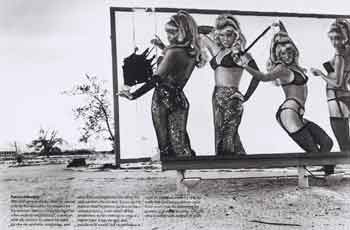
Victor Burgin uses the photographic image to comment on patriarchal dominance in western society. In his series US77 1977, the artist is particularly concerned with the external signs of male capitalist power in American society, as evidenced in architecture, on billboard posters, and in other media images. Like Bruce Nauman, he makes use of colloquial expressions as puns in many of his titles; in Burgin's case, however, language itself is distorted to fit the photographic image. Whereas Nauman uses the pun in a detached and ironic way, Burgin’s titles such as Patriarchitecture, Omnimpotence and Graffitication are direct comments on society.
The work of Duane Michals exemplifies the use of narrative in photography. The result, in many of his images, is an overall ambiguity of meaning.
The few photoworks cited here serve merely to draw attention to the scope of the medium. The aim of this exhibition is to present the new forms of visual expression and the conceptual propositions that have been generated by photographic artists in recent years.
Grazia Gunn
Return to main page for Reconstructed vision
more of Gael Newton's Essays and Articles
check-list: Photoworks 1965-1982: beyond the traditional use of photography
All measurements are given in centimetres, height before width.
Vito Acconci
United States born 1940 Cry baby, clock tower. 1977 18 panels: synthetic polymer paint, gelatin silver photographs, crayon, chalk and fibre-tipped pen on cardboard, I96.3 x 168.2 cm overall Purchased 1979
Giovanni Anselmo
Italy born 1934, Entering into my own work. 1971 gelatin silver photograph on photosensitized canvas
300.0 x 500.0 cm Purchased 1980
Marcel Broodthaers
Belgium, West Germany 1924-1976, La soupe de Daguerre. 1975 no.57 from an edition of 60, published by
Multiples Inc., New York, 1975, 12 Type C photographs and text on card, 52.8 x 51.4 cm overall, Purchased 1977
Victor Burgin
Great Britain born 1941 US77. 1977, from a series of 12 gelatin silver photographs Purchased 1983,
Patriarchitecture. 30.5 x 46.3 cm. Omnimpotence 30.5 x 46.4 cm. Graffitication 30.5 x 46.2 cm. Phallacy 30.5 x 46.3 cm
Christo
United States, France born 1935 Packed coast project for Australia, near Sydney. 1969
gelatin silver photograph, fabric, plastic, twine, pencil and crayon on cardboard 71.0 x 55.8 cm overall Purchased 1972
Wrapped coast, Little Bay. 1969 documentation, gelatin silver photograph by Shunk-Kender 101.5 x 127.0 cm
Gift of John Kaldor 1982
Jan Dibbets
The Netherlands born 1941 Comet horizon 6°-72° sky/sea/sky. 1973 12 Type C photographs and decal lettering
310.0 x 387.5 cm overall Purchased 1981
Hamish Fulton
Great Britain born 1946 Tasmania. 1979 4 panels: sepia-toned gelatin silver photographs and letterpress 98.5 x 80.2 cm;
108.1 x 71.1 cm; II 0.4 x 72.8 cm; 1 06.4 x 72.2 cm Purchased 1981
Joseph Kosuth
United States born 1945 One and three mirrors. 1965, mirror and 2 gelatin silver photographs each 122.0 x 122.0 cm
Purchased 1977
Les Krims
United States born 1943 Nude and smoking ashtray. 1971 From The only photographs in the world ever to cause a kidnapping portfolio, published by Light, New York, 1971 sepia-toned gelatin silver photograph 12.1 x 18.0 cm Purchased 1979
Nude man spraying the pubic area of nude woman. 1970 From The only photographs in the world ever to cause a kidnapping portfolio, published by Light, New York, 1971 sepia-toned gelatin silver photograph 12.1 x 18.0 cm Purchased 1979
Les Levine
Canada, United States born 1935 Abstract expression. 1 979 (Project for billboard)
3 Type C photographs and synthetic polymer paint on printed lettering 211.7 x 220.0 cm overall Purchased 1980
Richard Long
Great Britain born 1945 Stones in Morocco. 1979 5 gelatin silver photographs
38.6 x 57.2 cm; 38,4 x 57,2 cm; 56.6 x 38.5 cm; 38.2 x 56.2 cm; 38.4 x 56.7 cm Purchased 1982
Duane Michals
United States born 1932 Ideal city. 1980, oil on gelatin silver photograph 28.0 x 35.6 cm Purchased 1984
Portrait of John Shea with flowers. 1980 oil on gelatin silver photograph 28.0 x 35.6 cm Purchased 1984
Bruce Nauman
United States born 1941 Feet of clay. 1966-70 no.2 from an edition of 8 Type C photograph 50.0 x 60.4 cm Purchased 1978
Bound to fail. 1967 no.2 from an edition of 8 Type C photograph 50.0 x 60.4 cm Purchased 1978
Arnulf Rainer
Austria born 1929. Blaustern. 1969, crayon on gelatin silver photograph 60.0 x 50.0 cm Purchased 1982
Selbsterrustung. 1971 crayon on gelatin silver photograph 50.0 x 60.5 cm Purchased 1982
Face farce. 1972 crayon on gelatin silver photograph 50.0 x60.0 cm Purchased 1982
Death mask. 1978 oil on gelatin silver photograph 50.0 x 60.0 cm Purchased 1982
Robert Rooney
Australia born 1937 Garments. 1972-73 107 gelatin silver photographs 101.7 x 1 33.2 cm overall
15 quarto sheets of typescript documentation Gift of the Philip Morris Arts Grant 1982
Lucas Samaras
United States born 1936. Sittings 20 x 24 (3G). 10/28/80 Polaroid colour photograph 70.0 x 56.0 cm Purchased 1982
Sittings 20 x 24 (8A). 10/29/80 Polaroid colour photograph 71.0 x 56.0 cm Purchased 1982
Cindy Sherman
United States born 1954 Untitled. 1981 no.4 from an edition of 10 Type C photograph 61.5 x 123.4 cm Purchased 1983
Untitled. 1981 first of 2 artist’s proofs for an edition of 10 Type C photograph 61.5 x 1 23.0 cm Purchased 1983
Untitled. 1982 no.9 from an edition of 10 Type C photograph 115.1 x 76.0 cm Purchased 1983 Untitled. 1982
first of 2 artist’s proofs for an edition of 10 Type C photograph 114.5x76.0 cm Purchased 1983
Boyd Webb
New Zealand, Great Britain born 1 947 Approaching the Equator. 1977
2 Type C photographs and letterpress on card 63.2 x 81.2 cm overall Purchased 1979
No title (The swimmer). 1979 2 Type C photographs on card 91.4 x 66.0 cm overall Purchased 1979
William Wegman
United States born 1943 (Dog and cat). 1979 from the Improved Photographs portfolio, no.15 from an edition of 15, published by Multiples Inc., New York, 1979 silk-screen on gelatin silver photograph 40.4 x 50.4 cm Purchased 1980
(Dog with ears and whiskers). 1979 from the Improved Photographs portfolio, no.15 from an edition of 15, published by Multiples Inc., New York, 1979 silk-screen on gelatin silver photograph 50.4 x 40.6 cm Purchased 1980
Garry Willis
Australia born 1949 Naka naka (fit the Sixth). 1982 oil and pressure-sensitive plastic tape on 8 Type C photographs with plastic fringe 21 5.0 x 1 65.0 cm overall Purchased 1983
Text by Grazia Gunn; checklist compiled by Grazia Gunn and Michael Warden, Department of International Art.
Australian National Gallery
Return to main page for Reconstructed vision
more of Gael Newton's Essays and Articles
|