The context of Re-constructed Vision : related texts
Partial exposure
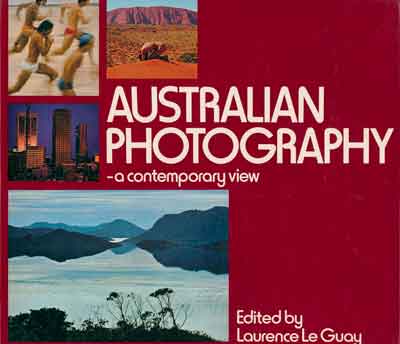
Australian Photography: a contemporary view - Lawrence Le Guay (ed.) - Publisher: James H. Coleman
Review by Gus Van der Heyde
This review originally published in Australian Book Review September 1979
Australia is in a period of intense social and political change when uniformity and prejudice are challenged by the increased consciousness and emergence of minority groups.
Changes in urban and rural environments are affecting social organisation and human behavior, world problems become community problems through the accelerating speed of communication and transportation.
It is interesting to note that none of these acute social changes seem to affect our contemporary photographers. That is, if the recently released book Australian Photography, a contemporary view is indeed a realistic cross-section of what is photographically produced in this country. |
|
As the introduction suggests, the purpose of this book is to sharpen the viewer’s awareness of the exciting contemporary possibilities of photography in Australia. Implying, correctly so, that an awareness of these possibilities is lacking somewhere. But unfortunately the possibilities here are somewhat one-sided.
This book certainly gives an admirable and in some cases quite exciting and stimulating account of what seems to go on in the art-photographers’ creative mind. Photographers who please themselves by expressing their own (?) ideas and attitudes without too much, if any, concern about the hopes and fears of humanity, Alex Poignant’s article excluded.
The photographers represented here do not stand alone. The Australian artist in general seems to be overwhelmed into inaction by society's complexities, retreating from the changes by refusing to recognise them and to tackle them head on. We indeed still seem to live in a lucky' country.
But what about ‘the other side’, e.g. the art of the mass media and in this case specifically the art of commercial photography? How is it possible that a book claiming to give a contemporary view of Australian photography omits blatantly so important and socially influential a photographic form of visual expression?
Is it perhaps, that a rather small but influential and self-indulgent clique of so-called art photographers have decided for themselves to wipe this form of photography off the pages of this ‘contemporary view’ because such photographs arce all made to express the ideas and aspirations of the clients who paid for them, and not of the artists who made them? An interesting thought.
This reviewer is fully aware of the abundantly clear tension which exists between those who see the camera basically as an instrument to copy, of reportage, and those who see photography as a subjective, expressive and emotional medium, very much like painting. But let's also keep in mind that commercial photography can sway many, many more people emotionally one way or another, without being vulgar and cheap, than art photography will ever be able to do.
In all fairness to the editor Laurence Le Guay and the publisher James H. Coleman, commercial photographers probably did not bother to submit material to make this book a truly contemporary view. If this was indeed the case, my apologies to the people concerned.
Some of my criticisms and assumptions should however not take away the significance of a publication like this. Photography in its purest form, without any commercial ties, should be exposed to the public at large as often and as much as possible.
Such exposure encourages many young photographers to keep working, keep experimenting and looking constantly for new forms of self-expression. Each publication, particularly if it is accompanied by or born out of an exhibition, as was this book, brings photography in Australia closer to its ultimate goal. This is to be not merely a craft or a pure form of art, but to be understood as an activity with social, political and psychological implications, practised in the light of what is being done overseas, but happening here.
The almost simultaneous transmission of photographic works and styles throughout the world by means of film and print has brought into being a universal pictorial vocabulary which is strongly evident in this publication. Most of the photographs could have been taken anywhere in the world. Unfortunately, the kind of pictorial information we have come to rely on so readily is severely restricting in respect of surface approximations.
Lacking the tonal and often textural qualities the originals, many reproductions in publication, also, fall short of conveying the experience that gave rise to the photographic works themselves, apart from the many photographs, the book also contains a brief introduction by the publisher, some general comments by the editor in relation to the photographs submitted and the ones published, and an interesting synopsis of the most important publications on photography in Australia by Gael Newton from the Art Gallery of NSW, followed by a simply illustrated and sincerely written account of his own views and developments in photography by Alex Poignant.
The obvious weakness of this book however, lies in the fact that not only is a false state of expectancy created, but that an effort to arrive at our own values rather than to accommodate photography to existing overseas criteria is absent. Photography in this country has yet to come to life as far as establishing a purely Australian identity. □
Gus Van de Hyde was teaching photography at RMIT
Gus (Guus) van der Heyde is an Amsterdam-born designer, photographer, and educator who served as a senior lecturer and Director of International Studies at RMIT University. Born in Amsterdam, he studied photography at the Arnhem Academy before working professionally in England and Switzerland. He migrated to Melbourne, Australia, in 1960. Shortly after arriving in Melbourne, he was hired by the World Record Club and began a prolific career in graphic design and album cover artwork, collaborating with prominent creatives like Athol Shmith. He later opened his own freelance design and photography business in 1963. He transitioned into academia, holding positions as a senior lecturer and Director of International Studies at RMIT University. As a prominent European émigré educator, his legacy and works have been featured in exhibitions celebrating mid-century modernism and European design impact in Australia, such as Melbourne Modern at the RMIT Gallery. He won the United Nations stamp design competition in 1981. Later in life, he co-founded Infinite Resources Consultancy before fully retiring to the Mornington Peninsula in 2003.
Return to main page for Reconstructed vision
more of Gael Newton's Essays and Articles
|