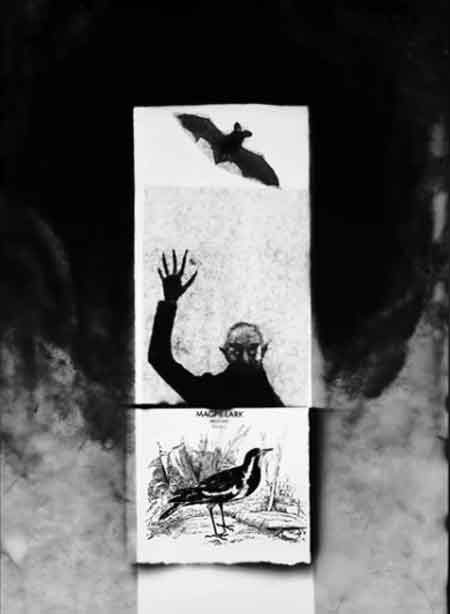
Susan Purdy (born 1957 in Melbourne) is a prominent contemporary Australian photo-media artist and educator. Based in the Strzelecki Ranges in Gippsland, Victoria, her practice is highly regarded for its sophisticated reinterpretation of early, camera-less photographic processes. Purdy frequently utilizes 19th-century techniques to bridge historical methods with contemporary concepts.
A significant portion of Purdy’s work centers on the photogram—a technique tracing back to William Henry Fox Talbot's 1834 "photogenic drawing." She creates these images by meticulously arranging physical objects directly onto light-sensitive photographic paper and exposing them to light.
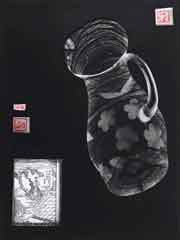
While traditional photograms yield flat white silhouettes on a dark background, Purdy discovered that by using transparent or semi-transparent objects (such as glass water jugs), she could capture refractions and gradients of light, inserting a sense of three-dimensional depth into a two-dimensional plane.
She heavily features cyanotypes (blueprints) and "nature printing" techniques (including rubbings, frottage, and soot prints) in her practice, embracing the unpredictable relationship between natural light and chemistry.
Purdy draws constant inspiration from the flora, fauna, and solitude of her surrounding Gippsland environment. Her botanical arrangements explore the energy, interconnectedness, and microcosms of living things.
Influenced by Buddhist concepts, Purdy views the deep black background of her photograms not as an empty abyss or dark matter, but as a meditative, healing void. To her, becoming "empty" represents a state of being enriched and entirely open to the universe.
Her imagery often subtly references her Asian heritage, cultural identity, and deep immersion in specific landscapes. This includes an extensive body of work generated during travels in Morocco, where she utilized the Sahara sun to create portable, gridded cyanotype works (such as Khetarra – Sharing Water from the Deep Well) that pay tribute to local culture and nomadic water management.
Purdy embraces the wild, unpredictable nature of camera-less photography. She balances deliberate, constructive planning with the organic elements of chance inherent to raw chemical exposures.
Her artwork has been exhibited widely in solo and group exhibitions since the 1980s and is represented in major public collections across Australia, including the National Gallery of Australia (NGA), the National Gallery of Victoria (NGV), the Latrobe Regional Gallery, the Gippsland Art Gallery, and the Museum of Australian Photography (MAPh).
 |
 |
 |
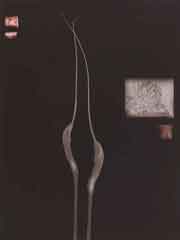
Brown pinella sultra, 2000
|
Golden Jug, 1999
|
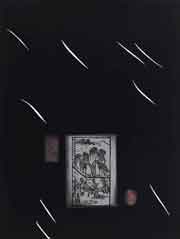
the places people died, 2001
|
Susan Purdy's web-site
Small essay, Gael Newton on Susan Purdy's Brown pinella sutra, 2000
return to photo-web contents page