Small essay Gael Newton 2004
In recent years, photographer Susan Purdy has focused on an exploration of her Chinese heritage, making works that investigate notions of origin, distance and difference. The series Nine dreams and a song, from which Brown pinella sutra comes, is dedicated to memory of David Nicholas and has personal significance for the artist as a memento mori.
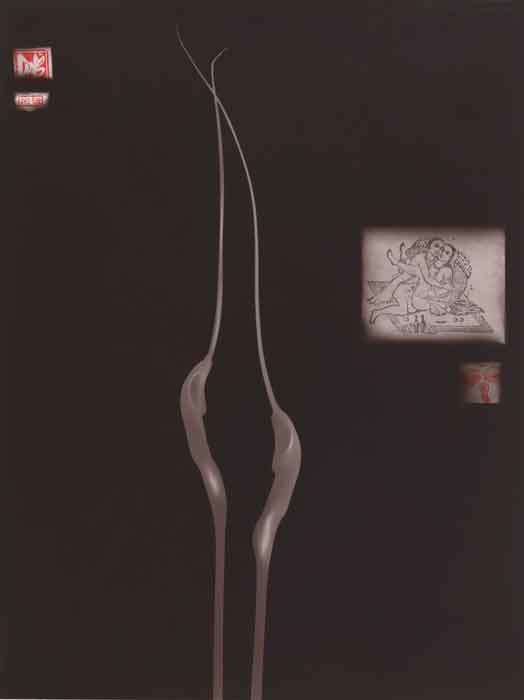
The photogram process is used here as a metaphor for the ephemeral nature of life: Purdy says of the series that
‘the technique of image making requires a light source be passed though the white flowers to record their pellucid forms on light sensitive paper. It parallels a Buddhist meditation on death where white light is imagined as passing through the body of a loved one’ and further comments that ‘the darkroom becomes a portal for journey into the underworld. A place to embrace darkness; there to compile an archive of shadows’.
The plant of Brown pinella sutra seemingly floats on soft brown background. Purdy uses plants in many of her series, referring the images back to pioneer photographer W. Henry Fox Talbot’s photogenic drawings of the 1840s.
Purdy’s choice of the photogram as a process – in which the actual object is placed directly on the sensitive paper and the image is made by light passing through it to the paper beneath – makes the final images a record of a quite intimate and special even ritualistic act.
About the vermilion stamps Purdy writes ‘the juxtaposition of red inside the black is symbolic of the scale and intensity of a single birth into the creation space’.
Created by light passing through an object and reversing the normal way of making a photograph, which is from negative to positive, photograms give rise to an interesting interplay between solid and void, a physical residue of what exists no longer. Through their impression upon the paper the objects recorded continue to live as ghosts caught in a twilight realm between life and death.
Return to Susan Purdy main page