Gael Newton AM 2004
Shayne Higson’s work is often quite poetic or dreamlike in appearance but has always had a strong political base.
‘My work has been primarily inspired by my physical environment but this then leads to a more complex and subjective exploration of an underlying content. The environments have ranged from the domestic and suburban, to the streets of New York and the Torres Straits Islands.’
Higson’s earliest works in the National Gallery of Australia collection incorporate elements and techniques from drawing and collage. ‘Disposable’, a photograph in which the image is heavily drawn over, evokes homeless souls in modern cities.
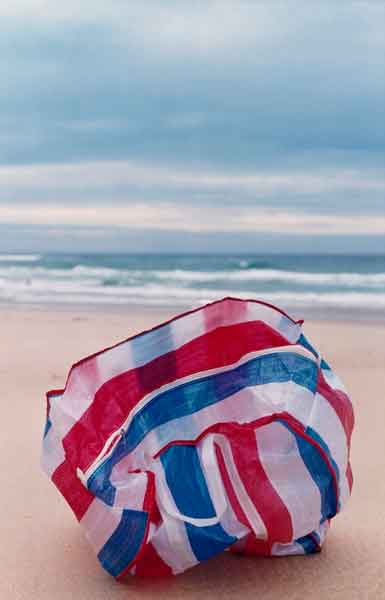
In recent years several of Higson’s series have been made in response to the debates about refugees seeking asylum in Australia. A series of photographs made in 2000 in which the artist has arranged found and constructed objects in the landscape, refer to an incident which happened at Scotts Head near her home on the north coast of New South Wales when a boat with Chinese refugees landed in the middle of the night.
Higson relates how ‘the boat carried sixty or more illegal immigrants from China and over the next three or four days most, if not all, were found, detained and deported. Left on the beach along with the rusty hulk, were the cheap red, white and blue striped bags in which these people had carried all their worldly goods including their ‘good suits and shoes’ which they had put on in a misguided attempt to blend in with the locals.’
A later series was in response to the drowning of 350 asylum seekers in the Java Sea in October 2001.
The striped plastic bag in Baggage is familiar to Australians as a shopping and travel accessory imported from Asia. The bag stands slightly fluffed up with air but poignantly unstable and about to be blown away out of sight. The title has several layers.
The ‘baggage’ which should be physically weighty now holds nothing. However, like ‘emotional baggage’ from the past the event has made its mark and will continue to weigh down and damage the future. The image also seems to mock the very weighty presence of a bronzed Aussie sunbaker in the now famous photograph taken in 1937 on a beach on the south coast by Max Dupain – a subtle point perhaps that Australians don’t want to see or know about the refugees coming in on the tide.
Return to Shayne Higson - main page