Devare & Co
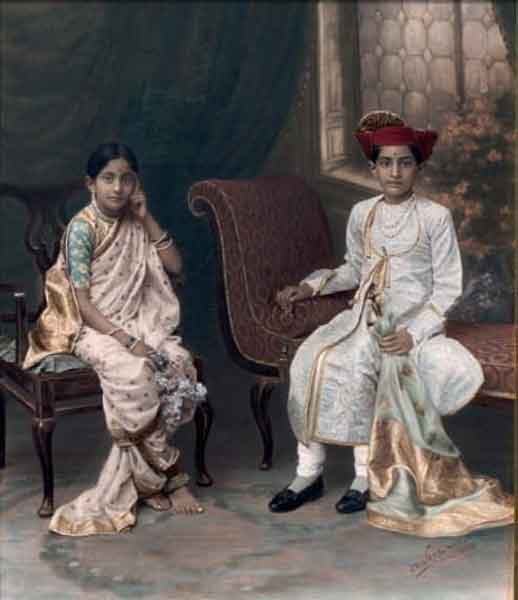
Prince Yeshwant Rao Holkar and his sister Manorama Raje
 |
Devare & Co, Gopinath Devare, photographer
Prince Yeshwant Rao Holkar and his sister Manorama Raje c.1916
Collection National Gallery of Australia (Canberra) |
Gael Newton AM, 2009
This graceful portrait of Prince Yeshwant, the eldest child of HH Maharaja Tukoji Rao 3rd of the Maratha state of Indore in Central India, and his younger sister Manorama Raje is an outstanding example of the distinctive genre of hand-coloured royal portrait photography popular in India in the early to mid twentieth century. The subtle colouring gives substance and life to the rich silks and satin garments worn by the young royals. The photograph was taken by court photographer Gopinath Devare, most likely at his studio in Bombay and perhaps prior to the prince going to Cheam School in England in 1920.
The Holkar children’s portrait is more complex than the standard royal portrait pose of a figure leaning up against a plinth or seated at a table. Prince Yeshwant and sister Manorama appear, instead, as if the photographer had come upon them in the corner of an English-style drawing room. The foreign setting might seem odd for a portrait of Indian royalty but European antiques were fashionable in the country’s palaces and photography studios; Indian photographers also adopted poses, props and backdrops from imported European portrait photographs. The inspiration for the setting was most likely the relaxed ‘at home’ style of the aristocratic portraiture known as a ‘conversazione’, or conversation piece, which was in vogue in Europe in the eighteenth and nineteenth centuries.
Prince Yeshwant acceded as Rao Holkar Bahadur, 14th Maharaja of Indore in 1926, but only assumed rule from 1930, after further Western education in England. He remained ruler of Indore until Indian Independence in 1947. Indore was then subsumed into the state of Madhya Pradesh. After his schooling, the prince developed a dislike of the British, although he maintained an appreciation for other parts of Europe and later enjoyed American culture. His second and third wives were American.
This high quality work by a twentieth-century Indian photographer is important to the National Gallery’s representation of the history of photography in Asia and has connections to other areas of the collection. Maharaja Yeshwant was an enthusiast for modern European art, furniture and architecture and had avant-garde photographer Man Ray take his first honeymoon photographs in Paris with Maharani Sanyogit Devi Holkar.
As soon as he was installed as ruler in 1930, Maharaja Yeshwant commissioned Eckart Muthesius, a young German architect, to build a new palace outside Indore. Called Manik Bagh (Jewel Gardens) the palace had white streamlined international-style architecture and was filled with modernist designer furniture and works of art, including a number of pieces by the Romanian sculptor Constantin Brancusi.
In 1936 the Maharaja purchased three late versions of Brancusi’s Bird in space—one in black marble, one in white marble and one in bronze—and commissioned the artist to design a ‘temple of meditation’ to house them in the palace grounds. Brancusi had various designs, including ones with a reflective water pool, and travelled to Indore in 1937 to begin work. By then, however, the Maharaja had apparently lost interest. He was possibly mourning for the death of the Maharania The work on the temple of meditation never began.
The Maharaja’s pair of marble ‘birds’ now reside in a different ‘temple of meditation’, inside the National Gallery of Australia. They were acquired from the Maharaja’s daughter in 1973. The Gallery’s display of the two stunning sculptures reflects some of Brancusi’s ideas for their installation in the Indore Royal palace garden.
Gopinath Devare became official photographer of all Indian States, and he and his associates at Devare & Co were active as photographers of the Imperial Durbar in 1911. Devare was reputedly the first Indian to be awarded Fellowship of the Royal Society of Photography in London. He travelled to Indore in May 1930 to record the prince’s investiture; the commemorative album opens with a tinted studio portrait of Yeshwant in the same delicate style as his earlier portrait.
Back to Devare & Co main page
more Gael Newton essays
