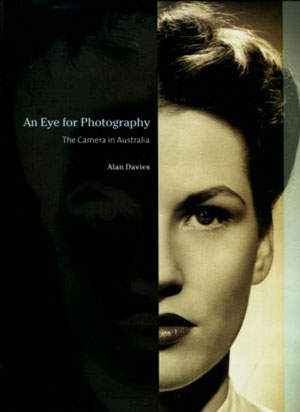
The Eye for Beauty (2004), written by Alan Davies, was published in conjunction with a major exhibition at the State Library of New South Wales and focussed on how Australian photographers at the turn of the 20th century sought to elevate photography from a mechanical process to a fine art.
The book focuses on the period between roughly 1890 and 1920, highlighting a movement that prioritized atmosphere, composition, and emotional expression over sharp-focus documentation. Davies illustrates how practitioners used specialized lenses, textured papers, and complex printing processes (like bromoil and gum bichromate) to create images that resembled charcoal drawings or tonalist paintings.
A central theme in the book is how Australian Pictorialists adapted European styles to the harsh, bright light of the Australian continent. Unlike the misty, atmospheric conditions of London or Paris, Australian photographers had to find "beauty" in the eucalyptus forests and bright coastal landscapes.
The text chronicles the social history of the movement, focusing on the amateur camera clubs in Sydney, Melbourne, and Adelaide that fostered this artistic revolution.The book provides detailed analysis and high-quality reproductions of works by several influential figures such as:
Harold Cazneaux cited as the "father" of Australian Pictorialism. Cazneaux's work captures the play of light in Sydney’s streets and harbors.
John Kauffmann was is creditted with introducing the Pictorialist style to Australia from Europe, focusing on soft, moody landscapes.
Cecil Bostock is known for his meticulous compositions and his role as a mentor to the next generation of modernists.
Henri Mallard captured the urban landscape and the construction of the Sydney Harbour Bridge with an artistic eye.
As the former Curator of Photographs at the State Library of NSW, Alan Davies utilized the library's vast Holtermann and Cazneaux collections. The publication is noted for its high production values, featuring over 100 duotone and color plates. This allows readers to see the subtle tonal shifts and textures that were essential to the original prints, many of which are now fragile museum artifacts.
Return to books
Return to Alan Davies
Return to photo-web contents page