The Far East magazine
The Far East was a news-magazine published by the Scottish journalist John Reddie Black in Yokohama, Japan, between 1870 and 1878.
It was illustrated with original, pasted-in photographs at a time when photomechanical reproduction was still in its infancy.
Rather than translating photographs into engravings (the norm for the period), Black mounted actual albumen prints onto the pages by hand.
It as the first newspaper in Japan to be illustrated with original photographs, and Black was reportedly inspired by the earlier success of the China Magazine published in Hong Kong.
During its run, The Far East published approximately 750 photographs, mostly of Japan and China, by at least 20 different photographers.
Because the prints were genuine photographs rather than artists' interpretations, surviving bound copies are now treasured as primary documents of early Meiji-era Japan and late-Qing China. Wikipedia
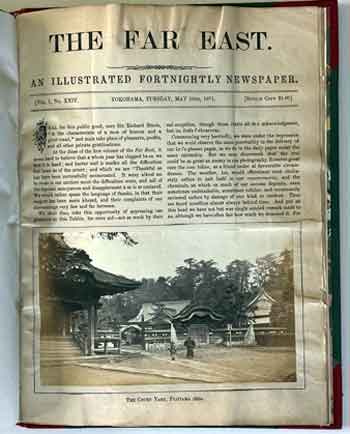
The magazine's publishing rhythm shifted over its life. The Far East began as a fortnightly publication, then, between June 1873 and October 1875, it was published monthly, and from 1876, publication was irregular. The first issue appeared on 30 May 1870.
The hand-mounted photographs were the operational heart and the bottleneck. Each copy literally had real prints pasted in, which limited print runs and made the magazine relatively expensive. In 1874, subscription prices were $4 quarterly, $7 semi-annually, and $13 annually, with prices slightly reduced by 1876 as circulation grew. Circulation was always modest: by 1876 it was probably around 300 readers, and between 1876 and 1878 the maximum was probably between 500 and 1,000.
Black had originally intended the publication to be ephemeral, but he found that his subscribers were binding copies up at some expense, and that he could charge a considerable premium for back issues; this encouraged him to expand the project.
Printing moved with Black himself. Issues were produced at various offices over the years, including the Japan Gazette printing office in Yokohama and later in Tokyo. From 1876, The Far East was published in Shanghai, where Black had settled, and accordingly the photographic subjects became predominantly Chinese.
The photographers
Black, an amateur photographer himself, contributed images and at times struggled to source enough material. For the China series he eventually had to travel to Shanghai to take the photographs himself.
His core staff photographer for the Japan years was Austrian: the in-house photographer was Michael Moser, but Black supplemented Moser's images with his own. Moser had arrived in Japan with the Austro-Hungarian expedition and worked for the paper until 1873.
The magazine also drew on leading photographers of the day. Significant photographers whose work appeared included Uchida Kuichi, the elder Suzuki Shin'ichi, and William Saunders. For the later Shanghai-based new series, principal contributors included William Saunders, Lorenzo F. Fisher, Thomas Child, and St. Julian Edwards. A notable quirk of the magazine is that the prints were generally not credited, so attributing individual images relies on later scholarship.
History and legacy
Black founded the magazine after a varied career. He had toured as a singer through Australia, India and China before settling in Japan.
Then he became a newspaper man, editing the Japan Herald and founding the Japan Gazette before launching The Far East with the stated aim of fostering "goodwill and brotherhood between the outer world and the subjects of the most ancient imperial dynasty of the world."
The publication wound down in the late 1870s. There is no evidence of further publication of The Far East after December 1878. Black went on to found the Far East Art Agency in Shanghai in 1876 and launched the Shanghai Mercury in 1879, before returning to Yokohama, where he died in 1880.
Today the magazine is essentially documentary and collectible. Complete or partial bound runs are sought-after rarities that appear at major auction houses. A first-year run can carry well over a hundred original prints. The magazine is a key reference point in the history of early photography in Japan and China, most notably catalogued in Terry Bennett's scholarship on the subject.
For historians, it offers a rare window into early Meiji society, landmarks, and daily life captured photographically rather than through an illustrator's hand, which is precisely what gives it lasting value.
There isn't a single complete, authoritative digital run of all volumes freely online; the holdings are scattered across the Internet Archive and various institutions, partly because complete physical runs are themselves rare.
Links
The National Gallery of Australia research library collections
More on Asia-Pacific Photography
photo-web contents page
