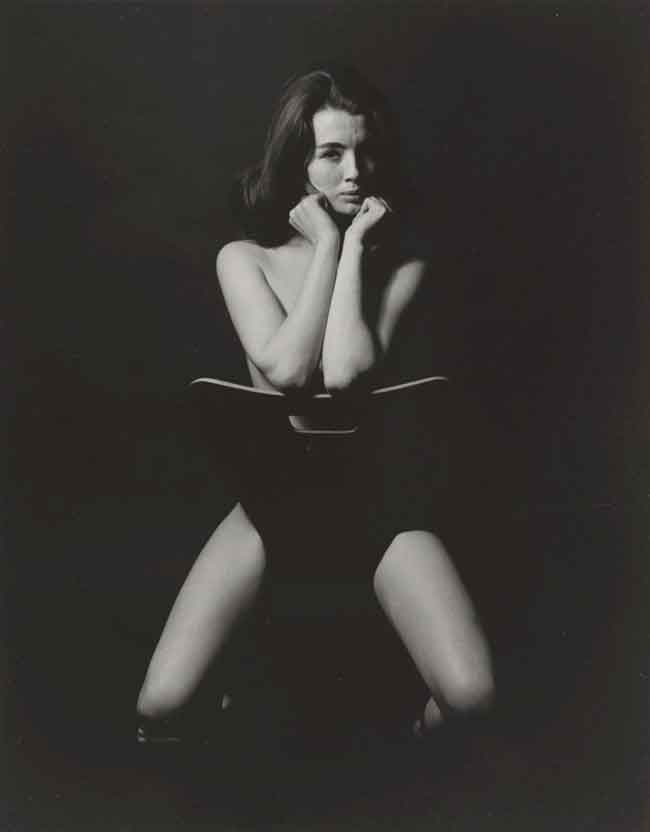
In 1963 London photographer and painter Lewis Morley was commissioned to take stills for a proposed film about the attractive 'good time' girl Christine Keeler, then at the centre of a high society and political sex scandal which would bring down a Tory government minister Lord Profumo.
In Morley's studio Keeler became increasingly tense in face of demands from the film promoters that she pose for the nude shots stipulated in her contract. Morley, who was an experienced theatre stills photographer known for his acute visual sense and economy of approach, quickly effected an inspired solution to a visual and ethical challenge.
He closed the set and working alone with Keeler directed her to disrobe and sit astride a classic modernist chair. It was an ironic conjunction worthy of a surrealist; Keeler was nude but her torso simultaneously concealed by a ‘double’ in the form of the sexy hour-glass shape of the chair. Initially to be cast in the picture as a centrefold girl Christine Keeler was in one moment given a respectable place in the grand tradition of the nude in art.
The 1963 film on Keeler did not happen but the photograph was endlessly published without Lewis Morley's consent becoming one of the most popular icons of an extraordinary era when Britain surprised the world as the locus of a cultural renaissance in the 'swinging sixties'.
In 1987 after being based in Australia since 1971, Morley was honoured with a retrospective at the National Portrait Gallery in London. The opening unexpectedly coincided with the release of a new feature film on the Profumo scandal reviving public interest in the Keeler image.
Over the ensuing decades the image has been endlessly used and abused but also creatively restruck in witty, salacious and politically potent take-offs.
Gael Newton AM, 2004
Return to Lewis Morley main page