 |
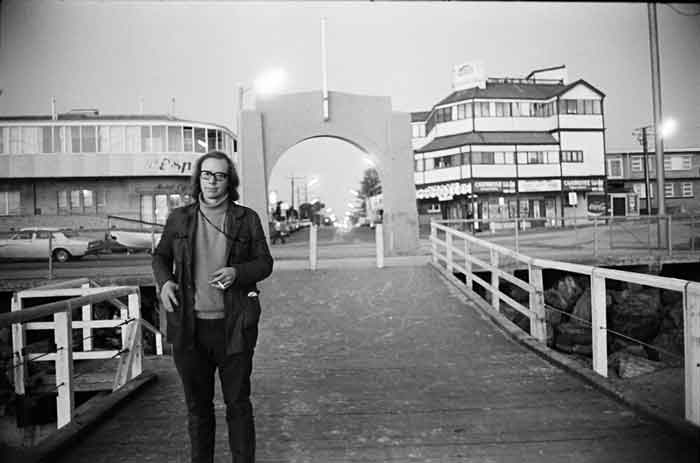
Robert McFarlane on Brighton jetty, Adelaide, South Australia, 1973, photo by Kathryn McFarlane
Collection National Library of Australia |
Robert McFarlane (1942–2023) was one of Australia's most quietly influential documentary photographers, a maker of images who was equally at home writing about the medium as practising it.
Born in Glenelg, in beachside Adelaide, he was given a Kodak Box Brownie at the age of nine, and as a teenager at Brighton High School he used a rangefinder camera to catch a teacher striking a pupil at assembly — an early sign of the watchful social conscience that would define his work.
Seeing the touring exhibition The Family of Man in Adelaide as a young man sealed the matter: it gave him a sense of the power of photography and cemented his lifelong humanist concerns. He moved to Sydney in 1963, freelancing for magazines including the Bulletin, Vogue Australia and Walkabout, and worked in London from 1969 to 1973 before returning home to settle into a career documenting Australian society.
Over the following decades McFarlane specialised in social and political subjects and in the performing arts, working as a stills photographer on many significant Australian films and theatre productions.
His 1964 photograph of the Aboriginal activist Charles Perkins on a Sydney bus remains one of his most recognisable images, and his portrait sitters ranged from Bob Hawke, Gough Whitlam and Weary Dunlop to the young Cate Blanchett and Geoffrey Rush.
He articulated a gentle counter to Cartier-Bresson's "decisive moment" — the idea of the "received moment", the sense that one does not so much take pictures as receive them from the subject.
Alongside the camera he sustained a parallel life in words, serving as photography critic for the Sydney Morning Herald for more than twenty-five years and maintaining OzPhotoReview, a blog devoted mainly to fine art and documentary photography in Australia.
He died in Adelaide on 19 July 2023, remembered as a generous and clear-eyed chronicler of his country and of the medium he loved.
More on Robert McFarlane
|